Azure vs AWS vs GCP: Comparison Cloud Computing Services Providers


With every year that passes, it becomes increasingly obvious that moving to the cloud is the only way businesses can compete effectively and remain important in the long run.
An increasing number of companies are embracing cloud computing, ranging from start-ups to Fortune 500 organizations, ensuring that CIOs and company owners alike have an overwhelming range of providers, services, and products, and hybrid solutions.
Likewise, IT professionals are looking at products to improve their skillsets and gain a competitive edge in the job market.
Gartner forecasts that the value of the global public cloud service market will increase to $331.2 billion by 2022; with a compound annual growth rate of 12.6%.

Points to Consider When Selecting a Cloud Service Provider
- Any specialist worth their salt would inform you that you can’t expect a one-size-fits-all approach when it comes to determining the sort of cloud services your company needs to run at full capacity.
- Each company has its own technical fingerprint; it has its own unique set of standards, goals and operational complexities that need to be taken into account.
Let’s take a close look at the industry’s top three names: Amazon Web Services (AWS), Microsoft Azure Cloud, and Google Cloud Platform (GCP).
Azure vs AWS vs Google Cloud Services: Pros & Cons
Microsoft Azure
Microsoft Azure: Microsoft turned up a little later than AWS on the cloud scene but undoubtedly made up for it by adopting its current on-site services (e.g. Windows Server, Office, SQL Server, SharePoint, Dynamics, etc.) to the cloud.
Azure is a direct rival to AWS, offering companies with a wide variety of features, Azure Cloud services, extensive open-source support, and simple integration with other Microsoft platforms.
According to the Microsoft Azure, when you compare AWS and Azure pricing
AWS is 5 times more expensive than Azure for Windows Server and SQL Server.
Being a product by Microsoft, Azure certainly benefits from customer familiarity with the brand, which generates an immediate affinity for Azure among loyal Microsoft clients.
Pros of Azure Cloud
- High availability
- Security
- Scalability
- Cost-effective
- IaaS and PaaS options
- Open source Support
- Hybrid cloud
Azure Cons
- Requires considerable management
- Limited backward compatibility
- Less enterprise-ready
- Additional charge for the pay-as-you-go option
Further Read: How Microsoft Growing Azure Cloud Computing Services vs AWS & Google Cloud Platform(GCP)
Amazon Web Services (AWS)
As one of the first cloud service providers, AWS jumped into the game early, gaining an incredible 33 percent market share and producing $1.4bn for Amazon alone in Q1 2018.
The greatest strength of AWS cloud development is undoubtedly its experience and supremacy in the cloud computing services industry, with its performance and popularity synonymous with the sheer size of its operations.
Related Read: Why to Prefer Leading AWS Solution Providers?
Gartner’s study on cloud IaaS vendors reveals that AWS continues to be a strong market leader, occupying the largest cloud market share and obviously benefiting from its early entrance into the cloud technology domain.

Pros of AWS
- Extensive range of infrastructure applications
- Highly flexible
- Cost-effective pricing model
- Rapid deployment
- Multiple datacenter “regions”
Cons
- Hybrid options available, but not a priority
- Legacy systems might take longer migration times
- The wide catalog of offerings can be difficult to navigate users
- AWS was late to provide on-demand billing for services
Google Cloud
Google Cloud Platform (GCP) obviously provides a more restricted range of services as a latecomer to the cloud industry and does not dominate the same regional array of data centers that AWS and Azure offer.
However, it does offer a highly specialized service to customers in three main streams:
- Big Data,
- Machine Learning (ML), and
- Data Analytics,
with decent scale and efficient load balancing, as well as low response times.c

Google’s container service offers users a big advantage, as it has established the Kubernetes standard now used by AWS and Azure.
In a hybrid approach, consumers continue to prefer Google cloud services as a secondary vendor, although it is becoming increasingly common with companies that are direct competitors with Amazon, and thus can not use AWS.
Pros of Google Cloud
- Great reputation in the open-source community
- Fast I/O
- Facilitates easy collaboration
- Second-to-none when it comes to building containers
- Greener than competitors
- Flexible pricing model
GCP Cons
- Does not support large, enterprise projects
- Limited choice of programming languages
- Fewer global data centers
- Complex transition from one vendor to another
Resource & Clients Comparison of Azure vs AWS vs GCP
We get this query a lot from our clients, in which one cloud computing platform is better as per their needs.
When it comes to selecting the right cloud computing partner you need to understand the comparison of Azure vs AWS vs Google Cloud.
Hence; there is a detailed description of each cloud computing platform.
Availability Zones
Amazon Web Services (AWS) being the first cloud computing platform has more expansion and time for establishment as compared to the other two platforms. On the other hand, Azure and Google Cloud are also expanding their operation centers around the world.
Talking about the number:
- AWS works on 66 availability zones and 12 more are coming soon as well.
- Microsoft Azure operates in 54 zones worldwide and it is available in more than 140 countries around the globe.
- Google Cloud Platform is available in 20 regions and they are planning to expand in three more regions as well.
Comparison of Top Companies as Client
When we have to try something new we first check what others are doing. Most importantly we check if our competitors are doing the same or not. Hence; we have created this list of companies that have adopted one of the three cloud computing platforms.
Amazon Web Services (AWS) Clients
As mentioned above Amazon Web Services (AWS) is the oldest player, hence it has a larger community and bigger user base.
AWS Cloud Services has some business leaders in its kitty like:
- Airbnb
- Netflix
- BMW
- Samsung
- Unilever
- Zynga
- MI
Explore more at AWS Customer Success Case Studies
Azure Client List
There is no doubt that Azure too is working hard to get the industry players.
Azure has a huge number of fortune 500 companies like
- Johnson Controls
- HP
- Fujifilm
- Polycom
- Honeywell
- Apple
Explore more at Customer and Partner Success Stories | Microsoft Azure
Google Cloud Clients
Google Cloud Development Services are gaining eyeballs because of its infrastructure the same as that of Google Search and YouTube. This has made several high-end companies to put trust on Google Cloud.
Here are a few top companies relying on Google Cloud:
- Bloomberg
- HSBC
- 20th Century Fox
- PayPal
- Dominos
Explore more at Google Cloud customers
Cloud Storage Comparison
All three cloud computing platforms serve the best storage services for all kinds of enterprises and small businesses.
AWS Cloud Storage Options
- With the help of Amazon S3, AWS serves object storage, Amazon EBS for Persistent Disk Storage, for cold storage it has Amazon Glacier, for data transfer AWS has Amazon Snowball.
Azure Blob Storage
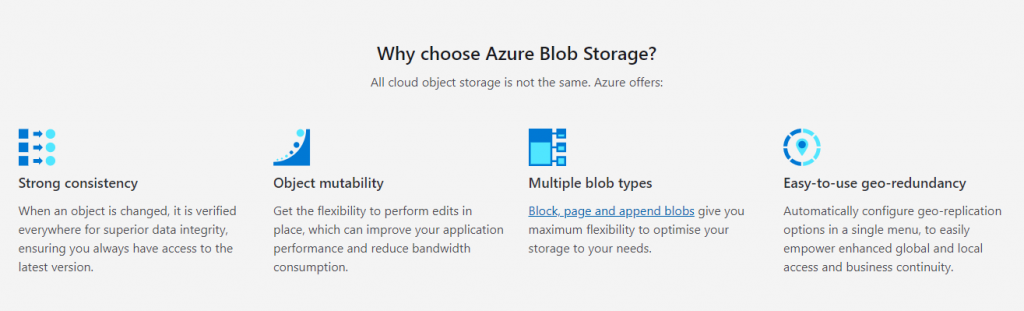
- Azure cloud computing uses Azure Blob Storage for Object storage, for persistent Disk Storage, it has Azure Managed Disks (HDD/SDD), for cold storage it has Azure Long-Term Storage, for File Storage Azure uses Azure files and finally for data transfer it has Azure Import/Export Service.
GCP Storage Options

- Google Cloud provides object storage from Google Cloud Storage, for persistent storage, it has persistent disk (HDD/SDD), for file storage it has Google Cloud Filestore, for cold storage Nearline and Coldline service is there and for data transfer, it provides storage transfer service.
Key Cloud Tools Comparison
Trending technologies have become an essential point in the differentiation of cloud computing service providers. All the three cloud vendors keep experimenting with the latest technologies like machine learning, artificial intelligence, serverless computing and the internet of things. Here are the key tools of each cloud computing platform.
Microsoft Azure Tools
- Microsoft is leveraging its top software MSFT along with some Cognitive services to compete in the race. Azure is offering machine learning, artificial intelligence and bot service to its users.

- There are other cognitive services as well like Computer vision API, Bing web search API, Custom Vision Service, Text Analytics API, and custom vision service.
Google Cloud Tools
- Google Cloud Platform has its main focus on AI, machine learning and IoT. It has an open-source software library for the development of machine learning applications which is known as TensorFlow.
- Google offers APIs for speech translation, natural language and many more. Google Along with this Google also has beta previews of IoT and Serverless service.
AWS Tools
- AWS has Sagemaker, artificial intelligence and machine learning has the top three major tools. For the training and deployment of machine learning models AWS has Sagemaker service.
- The Lex conversational interface empowers the Lambda serverless computing service, Alexa services, and Greengrass IoT messaging service. AWS provides Deeplens; for image and object recognition and optical character recognition.
What’s the Verdict?
Today AWS is the strong industry leader in the scope and breadth of features. This is because they have the industry knowledge and the expertise they need to deliver. But rivals such as Microsoft and Google aren’t that far behind.
Microsoft keeps on gaining ground on AWS. This is especially true in enterprise computing as they are a trusted brand with a consistent model for those who already use Microsoft products or languages in their organization.
Which is the Right Cloud Service Provider for my Business?
More than 80 percent of large corporations switched to a multi-cloud approach in 2018 alone; 51 percent opted for a hybrid cloud solution (combining private and public clouds).
If you’re searching for the right cloud vendor for your company, be sure to consider your unique needs and workload, and note that the response may be a combination of two or three cloud providers.
Don’t select a cloud computing service without making a detailed cloud vendor comparison.
Planning on migrating your operations to the cloud? Get in touch with us.
Related Cloud Computing Services | Development Articles
With over 10 years of experience in Tech industry at Samarpan Infotech with architect system, problem solving and creativity. "Today is the only day. Yesterday is gone".