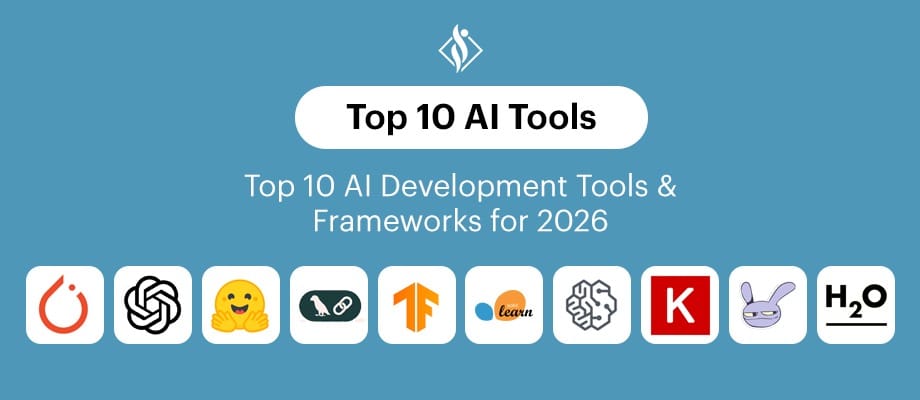
Top 10 AI Development Tools & Frameworks for 2026

Artificial Intelligence is now used for everything from chatbots and predictive analytics to document processing, recommendation engines, and generative AI applications. But building a successful AI solution depends heavily on choosing the right development tool, framework, or platform.
In this guide, we’ll compare the top 10 AI development tools and frameworks, including their key features, implementation requirements, pricing, adoption complexity, best use cases, and situations where each tool may not be the right fit.
Quick Summary of AI Development Tools & Frameworks
| # | Tool | Type | Best Audience | Learning Curve | Pricing | Best For | Adoption Complexity |
|---|---|---|---|---|---|---|---|
| 1 | PyTorch | Deep Learning Framework | ML Engineers, Researchers | Medium-High | Free (Open Source) | Custom AI Models, LLMs, Computer Vision, NLP | Medium-High |
| 2 | OpenAI Platform | AI API Platform | Product Teams, Developers | Low-Medium | Usage-Based | AI Assistants, Content Generation, Business Automation | Low-Medium |
| 3 | Hugging Face | AI Model Platform | Developers, ML Engineers | Medium | Free + Paid Plans | Generative AI, NLP, Chatbots, LLMs | Medium |
| 4 | LangChain & LangGraph | AI Agent & Workflow Framework | Developers, AI Engineers | Medium-High | Free (Open Source) | AI Agents, Workflow Automation, Knowledge Assistants | Medium-High |
| 5 | TensorFlow | Deep Learning Framework | Enterprise Teams, Production AI Teams | High | Free (Open Source) | Enterprise AI, Production ML, Mobile & Edge AI | Medium-High |
| 6 | Scikit-learn | Traditional ML Library | Data Scientists, Analysts | Low | Free (Open Source) | Predictive Analytics, Forecasting, Classification | Low-Medium |
| 7 | Amazon SageMaker | Managed ML Platform | Enterprises, AWS Teams | Medium-High | Pay-As-You-Go | Cloud AI, Model Training, MLOps, Deployment | Medium-High |
| 8 | Keras | High-Level Deep Learning Framework | Beginners, Startups, Educators | Low | Free (Open Source) | Rapid Prototyping, Neural Networks, AI MVPs | Low-Medium |
| 9 | JAX | Research & Numerical Computing Framework | AI Researchers, Advanced ML Teams | High | Free (Open Source) | Advanced AI Research, Scientific Computing, Large Models | High |
| 10 | H2O.ai | AutoML Platform | Business Teams, Analysts | Low-Medium | Free + Enterprise Licensing | AutoML, Predictive Analytics, Business AI | Low-Medium |
Top 10 AI Development Tools and Frameworks
1. PyTorch
PyTorch is an open-source machine learning framework developed by Meta AI and governed by the Linux Foundation, widely used for deep learning, computer vision, natural language processing, and generative AI applications. Its flexibility and dynamic computation graph make it a preferred choice for both AI researchers and production development teams.
Key Features
- Dynamic computation graph: PyTorch allows developers to change model behavior during execution, which makes experimentation and debugging easier.
- Strong GPU support: It works efficiently with GPUs, making it suitable for training deep learning models faster.
- Large AI ecosystem: PyTorch connects well with tools like TorchVision, TorchText, Hugging Face, and ONNX.
- Production deployment support: With TorchScript, torch.compile, and PyTorch Serve, models can be moved from research to production environments with optimized performance.
- Research-friendly structure: Its Python-first design makes it easier for AI researchers and developers to test new model architectures.
Implementation Requirements
- Programming expertise: Developers should have a working knowledge of Python, as most PyTorch development and model customization are performed using Python-based workflows.
- Machine learning fundamentals: Teams should understand concepts such as neural networks, model training, hyperparameter tuning, and data preprocessing to use the framework effectively.
- Computing resources: Small projects can run on standard CPUs, but deep learning and generative AI workloads typically require GPUs for practical training times.
- Data preparation capabilities: Organizations need access to clean, structured, and labeled data to achieve reliable model performance.
- Deployment infrastructure: Production environments may require cloud platforms, containerization tools, monitoring systems, and model-serving infrastructure.
Best For
- Custom deep learning model development
- Computer vision applications
- NLP and language-based AI systems
- Generative AI and LLM development
- Recommendation engines
- AI research and experimentation
When Not to Use
- Simple analytics or reporting projects
- Teams without machine learning expertise
- Projects that only need no-code or low-code AI tools
- Basic automation tasks without model training needs
- Projects where fast deployment is more important than model flexibility
Pricing
PyTorch is free and open-source. Main costs come from cloud computing, GPU usage, data storage, deployment, and AI development resources.
Adoption Complexity
Medium to High: easy for Python developers to start, but production AI requires machine learning, deployment, and infrastructure expertise.
2. OpenAI Platform
OpenAI Platform is a cloud-based AI development platform that allows developers and businesses to build applications using advanced language, vision, reasoning, and multimodal AI models. Through APIs, organizations can integrate AI capabilities into websites, mobile apps, customer support systems, business workflows, and enterprise software without building foundation models from scratch.
Key Features
- Advanced language models: Provides access to powerful AI models capable of content generation, summarization, reasoning, coding assistance, and conversational AI.
- Multimodal capabilities: Supports text, image, document, audio, and vision-based AI applications through a unified platform.
- API-first architecture: Developers can quickly integrate AI functionality into existing applications using APIs and SDKs.
- Function calling and automation: Allows AI models to interact with external systems, databases, and business tools to perform actions and automate workflows.
- Agentic workflow support: The Responses API and Agents SDK allow developers to build multi-step AI agents that can plan, use tools, and complete longer-horizon tasks with greater reliability.
- Realtime API for voice: Supports production-ready speech-to-speech voice agents with capabilities including tool use, image input, and phone calling through SIP integration.
- Scalable cloud infrastructure: OpenAI manages the underlying infrastructure, reducing the need for organizations to maintain AI training environments.
Implementation Requirements
- Programming expertise: Developers should be familiar with APIs, SDKs, and application development using languages such as Python, JavaScript, or C#.
- Prompt engineering skills: Teams should understand how to design prompts, instructions, and workflows to improve AI output quality.
- Application architecture planning: Organizations need a strategy for managing conversations, user interactions, and AI-generated responses.
- Security and compliance controls: Sensitive industries may require data governance, privacy policies, and compliance reviews before deployment.
- API budget management: Teams should estimate usage volumes and monitor token consumption to control operational costs.
Best For
- AI chatbots and virtual assistants
- Customer support automation
- Content generation and marketing tools
- Document analysis and processing
- AI-powered business applications
- Workflow automation and productivity tools
- AI agent and multi-step workflow automation
When Not to Use
- Projects requiring complete offline deployment
- Organizations that cannot use third-party cloud services
- Applications requiring extensive custom model training
- Simple automation tasks that do not require AI
- Projects with highly unpredictable API usage and budget constraints
Pricing
OpenAI uses a usage-based pricing model. Costs vary based on the model used, input and output tokens processed, API requests, and additional services such as image generation, voice, or advanced reasoning models.
Adoption Complexity
Low to Medium: OpenAI is one of the easiest AI platforms to adopt because infrastructure and model management are handled by OpenAI. However, building reliable production applications still requires prompt design, integration expertise, and governance planning.
3. Hugging Face
Hugging Face is one of the most popular AI development platforms for natural language processing (NLP), large language models (LLMs), and generative AI applications. It provides access to over 2 million pre-trained AI models and development tools that help organizations build chatbots, document processing systems, content generation tools, and AI assistants without training models from scratch.
Key Features
- Extensive model library: Provides access to over 2 million pre-trained models for text generation, classification, summarization, translation, image processing, and more.
- Transformers framework: The Transformers library simplifies the implementation and fine-tuning of modern AI models such as BERT, GPT, Llama, and Mistral.
- Model Hub: Developers can easily discover, download, share, and deploy open-source AI models.
- Fine-tuning support: Organizations can customize existing models using their own business data instead of building models from scratch.
- Multi-framework compatibility: Works seamlessly with PyTorch, TensorFlow, and JAX, giving developers flexibility in their AI development stack.
Implementation Requirements
- Programming expertise: Developers should have Python knowledge and familiarity with AI development workflows.
- Machine learning fundamentals: Teams should understand NLP concepts, model fine-tuning, embeddings, tokenization, and model evaluation.
- Computing resources: Smaller models can run on CPUs, while larger language models typically require GPUs for training and inference.
- Data preparation capabilities: Custom model fine-tuning requires clean, structured, and domain-specific training data.
- Deployment infrastructure: Production deployments may require cloud infrastructure, model hosting services, APIs, and monitoring tools.
Best For
- Generative AI applications
- Large language model development
- Chatbots and virtual assistants
- Document processing and analysis
- Sentiment analysis and text classification
- Translation and summarization tools
When Not to Use
- Projects that do not involve NLP or generative AI
- Teams without machine learning or Python expertise
- Simple rule-based automation systems
- Applications requiring only traditional machine learning algorithms
- Projects with extremely limited computing resources
Pricing
Hugging Face follows a tiered pricing model.
- The free plan covers core community use, including access to public models, datasets, and spaces.
- The Pro plan is $9/month for individual developers needing more compute and private storage.
- The Team plan is $20 per user/month for collaborative workspaces with shared billing.
- The Enterprise plan starts at $50 per user/month and includes custom onboarding, advanced security features, and dedicated support.
- Additional variable costs apply for inference endpoints, GPU compute, and cloud infrastructure depending on usage.
Adoption Complexity
Medium: Hugging Face simplifies access to advanced AI models, but successful implementation still requires machine learning knowledge, model selection expertise, and deployment planning.
4. LangChain & LangGraph
LangChain and LangGraph are open-source frameworks designed for building AI-powered applications, intelligent workflows, and AI agents using large language models (LLMs). Both frameworks reached their v1.0 milestones in October 2025, marking their transition from prototype tools to production-class platforms. LangChain serves as the high-level toolkit, connecting AI models with external tools, APIs, databases, and business systems through 600+ provider integrations.
LangGraph serves as the low-level runtime layer, enabling reliable production-grade AI agents with loops, retries, human review checkpoints, and state that persists across failures. Together, they have become popular choices for organizations building advanced AI assistants, customer support systems, document intelligence platforms, and workflow automation solutions.
Key Features
- LLM orchestration: Helps developers connect language models with databases, APIs, documents, and external applications to create more useful AI systems.
- Agent development capabilities: Enables AI applications to make decisions, perform actions, and execute multi-step workflows rather than simply generating responses.
- Memory management: Allows AI applications to maintain context across conversations and interactions, improving user experience.
- Workflow automation: Supports complex business processes by connecting AI models with multiple systems and decision points.
- LangGraph state management: Helps developers build reliable multi-agent and long-running AI workflows with better control over execution paths, including loops, branching logic, and human-in-the-loop interventions.
Implementation Requirements
- Programming expertise: Developers should have experience with Python, APIs, and application development concepts.
- LLM understanding: Teams should understand prompt engineering, retrieval techniques, AI agents, and language model behavior.
- External system integration: Successful implementations often require connections to databases, APIs, document repositories, and business software.
- Infrastructure planning: Production deployments may require cloud hosting, vector databases, monitoring tools, and security controls.
- Application design skills: Teams should be able to design workflows, decision trees, and agent interactions that align with business goals.
Best For
- AI agents and autonomous workflows
- Customer support automation
- Enterprise knowledge assistants
- Document search and question-answering systems
- AI-powered business applications
- Multi-step workflow automation
- Internal productivity and operations tools
When Not to Use
- Simple chatbot projects that only require direct API access to AI models
- Applications that do not need external data sources or integrations
- Small projects with limited technical resources
- Traditional machine learning or predictive analytics projects
- Teams without application development expertise
Pricing
LangChain and LangGraph are open-source and free to use. Costs typically come from AI model APIs, vector databases, cloud infrastructure, monitoring tools, and development resources.
Adoption Complexity
Medium to High: Basic AI applications can be built relatively quickly, but developing reliable AI agents, workflow automation systems, and enterprise-grade applications requires strong architectural planning and integration expertise.
5. TensorFlow
TensorFlow is an open-source machine learning framework developed by Google and widely used for building, training, and deploying AI models at scale. It supports deep learning, neural networks, computer vision, NLP, predictive analytics, and production-grade AI applications.
TensorFlow is often preferred by enterprises because it offers strong deployment tools, cloud integration, and support for mobile and edge AI. Note that Google’s own internal development has largely shifted to JAX for new model work, which may affect long-term community investment in TensorFlow.
Key Features
- End-to-end AI development: TensorFlow supports the complete machine learning workflow, from model building and training to deployment and monitoring.
- Strong production support: It is suitable for enterprise-grade AI applications that need stable deployment, scalability, and long-term maintenance.
- TensorFlow Lite (now rebranded as LiteRT): This allows developers to deploy AI models on mobile devices, embedded systems, and edge devices with lower computing power.
- TensorFlow Extended (TFX): TFX helps teams build production-ready machine learning pipelines with data validation, model analysis, and workflow automation.
- Large ecosystem: TensorFlow connects well with Google Cloud, Keras, TensorBoard, TensorFlow Hub, and other AI development tools.
Implementation Requirements
- Programming expertise: Developers should have a working knowledge of Python, as most TensorFlow development is done through Python-based APIs and libraries.
- Machine learning knowledge: Teams should understand neural networks, model training, data preprocessing, evaluation metrics, and optimization techniques.
- Computing resources: Small models can run on CPUs, but deep learning workloads usually require GPUs, TPUs, or cloud-based compute resources.
- Deployment planning: Production use may require TensorFlow Serving, TensorFlow Lite, cloud infrastructure, APIs, and monitoring systems.
- MLOps readiness: Enterprise teams may need CI/CD pipelines, model versioning, data validation, and retraining workflows for long-term reliability.
Best For
- Enterprise AI application development
- Production-ready machine learning systems
- Mobile and edge AI deployment
- Computer vision and NLP applications
- Predictive analytics and deep learning projects
- Large-scale model training and deployment
When Not to Use
- Projects that need very quick experimentation with minimal setup
- Small teams without machine learning or deployment experience
- Simple business reporting or basic analytics tasks
- Projects where a lightweight ML library is enough
- Use cases that only require API-based AI without custom model development
- Teams evaluating long-term framework strategy, given Google’s internal shift toward JAX for new development
Pricing
TensorFlow is free and open-source. Main costs come from cloud computing, GPU or TPU usage, data storage, model deployment, monitoring, and AI development resources.
Adoption Complexity
Medium to High: TensorFlow is powerful and enterprise-ready, but it can feel more complex than beginner-friendly tools. Production deployment usually requires machine learning, cloud, and MLOps expertise.
6. Scikit-learn
Scikit-learn is one of the most widely used machine learning libraries for building traditional AI and predictive analytics solutions. Unlike deep learning frameworks that focus on neural networks and generative AI, Scikit-learn specializes in structured data analysis, classification, regression, clustering, forecasting, and statistical modeling.
Its simplicity, extensive documentation, and strong community support make it a popular choice for data scientists, analysts, and businesses looking to implement machine learning solutions quickly.
Key Features
- Comprehensive machine learning algorithms: Provides a wide range of algorithms for classification, regression, clustering, dimensionality reduction, and anomaly detection.
- Simple and consistent API: Makes it easier for developers and data scientists to build, train, and evaluate machine learning models.
- Data preprocessing tools: Includes built-in functionality for feature scaling, encoding, normalization, and data transformation.
- Pipeline and deployment support: The Pipeline and Column Transformer features allow teams to combine preprocessing and modeling steps into a single deployable workflow, making production deployment cleaner and more reliable.
- Model evaluation capabilities: Offers cross-validation, performance metrics, and model selection tools to improve prediction accuracy.
- Strong ecosystem integration: Works seamlessly with NumPy, Pandas, Matplotlib, and other popular Python data science libraries.
Implementation Requirements
- Programming expertise: Developers should have basic Python programming knowledge and familiarity with data analysis concepts.
- Machine learning fundamentals: Teams should understand supervised learning, unsupervised learning, feature engineering, and model evaluation techniques.
- Computing resources: Most Scikit-learn models can run efficiently on standard CPUs without requiring specialized GPU hardware.
- Data preparation capabilities: Success depends on having clean, structured, and properly formatted datasets.
- Analytical skills: Teams should be able to interpret model outputs, evaluate performance metrics, and make data-driven decisions.
Best For
- Predictive analytics projects
- Customer segmentation and clustering
- Fraud detection systems
- Sales and demand forecasting
- Churn prediction and customer retention modeling
- Risk assessment and scoring models
- Business intelligence and analytics
- Structured data machine learning projects
When Not to Use
- Large language model development
- Generative AI applications
- Advanced deep learning projects
- Computer vision systems requiring neural networks
- Projects that need GPU-accelerated model training
- Complex AI applications with unstructured data
Pricing
Scikit-learn is completely free and open-source. Costs generally come from data storage, cloud infrastructure, development resources, and deployment environments.
Adoption Complexity
Low to Medium: Scikit-learn is considered one of the easiest machine learning libraries to learn and implement. Most teams can build useful predictive models without extensive deep learning expertise, making it ideal for businesses starting their AI journey.
7. Amazon SageMaker
Amazon SageMaker is a fully managed machine learning platform from Amazon Web Services (AWS) that helps organizations build, train, deploy, and monitor AI models at scale. Instead of managing infrastructure manually, businesses can use SageMaker to streamline the entire machine learning lifecycle through a single platform. It is widely adopted by enterprises already using AWS and looking for a scalable environment for AI development and deployment.
Key Features
- End-to-end machine learning platform: Supports data preparation, model training, deployment, monitoring, and management from a single environment.
- Managed infrastructure: Eliminates the need to provision and maintain servers, GPUs, and machine learning infrastructure manually.
- Built-in machine learning tools: Provides pre-built algorithms, notebooks, AutoML capabilities, and model management features to accelerate development.
- Scalable model deployment: Makes it easier to deploy AI models into production and automatically scale resources based on demand.
- SageMaker Unified Studio: A centralized development environment that bridges data engineering and ML operations, allowing teams to manage data assets, models, AI agents, and reports in a controlled and collaborative workspace.
- AWS ecosystem integration: Connects seamlessly with services such as Amazon S3, Lambda, Redshift, DynamoDB, and other AWS offerings.
Implementation Requirements
- AWS expertise: Teams should understand AWS services, cloud architecture, and security best practices.
- Machine learning knowledge: Developers and data scientists should be familiar with model training, evaluation, and deployment processes.
- Cloud infrastructure planning: Organizations need an AWS environment with proper permissions, storage, networking, and governance policies.
- Data management capabilities: Training datasets are commonly stored in Amazon S3 and require proper organization and accessibility.
- Operational monitoring: Production AI systems require monitoring, version control, retraining strategies, and cost management processes.
Best For
- Enterprise AI initiatives
- Cloud-based machine learning projects
- Large-scale AI model deployment
- Organizations already using AWS
- Predictive analytics and forecasting
- MLOps and machine learning lifecycle management
- Generative AI and foundation model deployment
When Not to Use
- Small AI projects with limited budgets
- Organizations that do not use AWS infrastructure
- Teams without cloud or machine learning expertise
- Simple analytics projects that don’t require managed ML services
- Businesses looking for a lightweight AI development framework
- Organizations with multi-cloud strategies or those concerned about vendor lock-in, as SageMaker’s proprietary APIs are tightly coupled to the AWS ecosystem
Pricing
Amazon SageMaker follows a pay-as-you-go pricing model. Costs depend on compute instances, storage usage, model training duration, deployment resources, data processing, and additional AWS services used within the environment.
Adoption Complexity
Medium to High: SageMaker simplifies infrastructure management but still requires cloud architecture knowledge, machine learning expertise, and ongoing operational management to fully utilize its capabilities.
8. Keras
Keras is a high-level deep learning framework designed to simplify the process of building, training, and deploying neural networks. Originally developed as an independent library and now tightly integrated with TensorFlow, Keras allows developers to create complex AI models with significantly less code. Its user-friendly approach makes it popular among beginners, startups, educators, and teams looking to rapidly prototype AI solutions.
Key Features
- Simplified deep learning development: Provides an intuitive API that reduces the complexity of building neural networks and AI models.
- Rapid prototyping capabilities: Allows developers to quickly test ideas, model architectures, and AI concepts with minimal coding effort.
- Seamless TensorFlow integration: Works directly with TensorFlow, enabling access to enterprise-grade deployment and scalability features.
- Pre-built neural network components: Includes ready-to-use layers, activation functions, optimizers, and loss functions that accelerate development.
- Multi-backend support: Keras 3 supports multiple backends including TensorFlow, PyTorch, JAX, and OpenVINO for inference-only deployments, giving developers greater flexibility and the ability to optimize performance across different hardware environments.
- KerasHub: Provides Keras 3 implementations of popular model architectures paired with pretrained checkpoints, allowing developers to access and fine-tune state-of-the-art models across TensorFlow, JAX, and PyTorch backends without starting from scratch.
Implementation Requirements
- Programming expertise: Developers should have basic Python programming knowledge and an understanding of object-oriented programming concepts.
- Machine learning fundamentals: Teams should understand neural networks, training processes, model evaluation, and data preprocessing.
- Computing resources: Small projects can run on CPUs, while larger deep learning workloads benefit from GPU acceleration.
- Data preparation capabilities: Clean, structured, and properly labeled training data is required to achieve effective results.
- Development environment: Keras is commonly used alongside TensorFlow, Jupyter Notebooks, and popular Python data science libraries.
Best For
- Rapid AI prototyping
- Deep learning beginners
- Neural network development
- Educational and training projects
- Startups building MVP AI solutions
- Computer vision and NLP prototypes
- Teams seeking faster AI development
When Not to Use
- Highly customized deep learning research projects
- Organizations requiring maximum model-level control
- Large-scale distributed AI training environments
- Advanced AI research involving experimental architectures
- Projects where framework flexibility is more important than simplicity
Pricing
Keras is free and open-source. Costs mainly come from cloud infrastructure, GPU resources, data storage, deployment environments, and development resources.
Adoption Complexity
Low to Medium: Keras is one of the easiest deep learning frameworks to learn and implement. Its simplified API reduces the learning curve significantly, making it ideal for beginners and organizations looking to quickly develop AI solutions.
9. JAX
JAX is an open-source machine learning framework developed by Google that focuses on high-performance numerical computing and advanced AI research. It combines NumPy-like programming with automatic differentiation and hardware acceleration, making it a popular choice for researchers working on large language models, scientific computing, robotics, and next-generation AI systems.
JAX has grown significantly beyond its Google origins, with leading AI organizations including Anthropic, xAI, and Apple now using it to build their foundation models, making it one of the most credible and widely adopted frameworks for serious AI development in 2026.
Key Features
- Automatic differentiation: Automatically calculates gradients for machine learning models, making training and optimization more efficient.
- High-performance computing: Optimized for GPUs and TPUs, allowing researchers to train large and complex AI models faster.
- NumPy-compatible syntax: Uses a familiar programming style for Python developers and data scientists already working with NumPy.
- Parallel and distributed processing: Supports large-scale model training across multiple devices and cloud environments.
- Research-focused flexibility: Makes it easier to experiment with custom architectures, algorithms, and advanced AI techniques.
- JAX AI Stack: A production-ready ecosystem of loosely coupled libraries built on top of JAX’s core, including Flax for model development, Optax for optimization, Grain for data pipelines, and Orbax for checkpointing, alongside production tools like MaxText and vLLM for large-scale deployment.
Implementation Requirements
- Programming expertise: Developers should have strong Python programming skills and experience working with machine learning frameworks.
- Advanced machine learning knowledge: Teams should understand deep learning, optimization techniques, neural network architectures, and mathematical concepts behind AI models.
- Computing resources: JAX is most effective when paired with GPUs, TPUs, or cloud-based high-performance computing environments.
- Data preparation capabilities: Large-scale AI projects require clean, structured, and properly prepared datasets for model training.
- Research-oriented team: Organizations typically need experienced AI researchers, machine learning engineers, or data scientists to fully leverage JAX.
Best For
- AI research and experimentation
- Large language model development
- Scientific computing applications
- High-performance machine learning
- Advanced neural network architectures
- Robotics and simulation projects
- TPU-based AI workloads
When Not to Use
- Beginner AI or machine learning projects
- Teams without deep learning expertise
- Simple predictive analytics tasks
- Rapid business application development
- Projects requiring minimal setup and learning curve
- Organizations seeking low-code AI solutions
Pricing
JAX is free and open-source. Costs primarily come from GPU or TPU infrastructure, cloud computing resources, data storage, and specialized AI development talent.
Adoption Complexity
High: JAX offers exceptional performance and flexibility but requires strong machine learning expertise and familiarity with advanced AI concepts. It is generally better suited for research teams and organizations building sophisticated AI systems than for beginners.
10. H2O.ai
H2O.ai is an AI and machine learning platform focused on automated machine learning (AutoML), predictive analytics, and enterprise AI adoption. It helps organizations build machine learning models faster by automating many of the complex tasks involved in model selection, feature engineering, hyperparameter tuning, and deployment.
H2O.ai has expanded beyond its AutoML roots to include generative AI capabilities through its enterprise platform h2oGPTe, which supports agentic AI, retrieval-augmented generation (RAG), and Sovereign AI deployment for organizations requiring secure, controlled AI environments. It is particularly popular in industries such as insurance, banking, healthcare, telecommunications, retail, and government where businesses want to leverage AI without requiring large teams of machine learning specialists.
Key Features
- Automated machine learning (AutoML): Automatically tests multiple algorithms and configurations to identify the best-performing model with minimal manual effort.
- Predictive analytics capabilities: Helps organizations build forecasting, risk scoring, customer segmentation, and decision-support models.
- Explainable AI tools: Provides transparency into model predictions, making it easier to understand and validate AI-driven decisions.
- h2oGPTe generative AI platform: H2O.ai’s enterprise generative AI platform supports agentic AI workflows, RAG-based document intelligence, and Sovereign AI deployment across private cloud, on-premises, and hybrid environments, giving regulated industries full control over how AI is deployed and used.
- Enterprise deployment support: Includes tools for deploying, monitoring, and managing AI models in production environments.
- Scalable AI platform: Supports large datasets and enterprise workloads across cloud, on-premise, and hybrid infrastructures.
Implementation Requirements
- Data analysis knowledge: Teams should understand business data, analytics workflows, and machine learning objectives.
- Basic machine learning understanding: While AutoML reduces complexity, users should still understand model evaluation, accuracy metrics, and business outcomes.
- Data preparation capabilities: Organizations need clean, structured, and relevant datasets to generate reliable predictions.
- Infrastructure planning: Deployments may require cloud platforms, servers, databases, and monitoring solutions depending on project scale.
- Business stakeholder involvement: Domain experts are often needed to validate model outputs and ensure business relevance.
Best For
- Automated machine learning projects
- Predictive analytics and forecasting
- Insurance risk modeling
- Banking and financial analytics
- Healthcare data analysis
- Customer segmentation and churn prediction
- Government and regulated industry AI deployments requiring secure and compliant environments
- Organizations adopting AI with limited ML resources
When Not to Use
- Large language model development from scratch
- Advanced deep learning research
- Computer vision projects requiring custom neural networks
- Organizations seeking complete control over model architecture
- Highly experimental AI research projects
Pricing
H2O.ai offers open-source products that are free to use, along with enterprise solutions that require custom licensing. Additional costs may include infrastructure, cloud resources, deployment environments, and implementation services.
Adoption Complexity
Low to Medium: H2O.ai is designed to simplify AI adoption and reduce the need for extensive machine learning expertise. Business analysts, data teams, and organizations beginning their AI journey can often achieve results faster compared to traditional machine learning frameworks.
Conclusion
The AI development landscape gives businesses many ways to build smarter applications, automate workflows, and turn data into actionable insights. However, there is no one-size-fits-all solution. Frameworks such as PyTorch and TensorFlow are ideal for custom AI model development, while platforms like OpenAI, Hugging Face, and LangChain help accelerate generative AI and AI-powered application development. Similarly, tools such as Amazon SageMaker and H2O.ai simplify machine learning deployment and enterprise AI adoption.
Selecting the right framework is only the first step. Successful AI initiatives require the right strategy, architecture, data preparation, integration approach, and ongoing optimization. Our expert AI integration services help businesses identify the most suitable AI technologies, integrate them seamlessly with existing systems, and build scalable AI solutions that deliver measurable business outcomes and long-term value.
With over 10 years of experience in Tech industry at Samarpan Infotech with architect system, problem solving and creativity. "Today is the only day. Yesterday is gone".