How Microsoft Growing Azure Cloud Computing Services vs AWS, GCP


The Cloud computing service has given rise to a multi-billion dollar economy. Even though the cloud market is still a confusing subject to many, there are industry giants like Microsoft Azure, Amazon Web Services (AWS) and Google Cloud which are already competing to be on the top.
Among all these top cloud service providers Microsoft Azure is leading because of its amazing features and global presence.
This blog is written with an objective to explain the important aspects of cloud computing and why Microsoft Azure is the right choice for businesses.
Let’s begin with some facts and numbers about cloud computing and Microsoft Azure.
Cloud Market Share
Today, cloud computing has a complex ecosystem of services, technologies, and products. Every cloud provider is competing for its expansion. As per the recent report from RightScale, 91 percent of the businesses are using public cloud computing services, 72 percent have opted for a private cloud solution and 69 percent are relying on a hybrid cloud solution.
The worldwide expenditure on the public cloud services and its infrastructure is going to expand double within the next five years. The present number is $229 billion which will grow to $500 billion by 2023.
Based on a report from IDC

Microsoft Azure Cloud Market Share
When you will visit the official website of Microsoft Azure, you will see they have mentioned some fascinating numerical facts. Azure has more than 90 compliance offerings; It provides the most comprehensive compliance coverage as compared to any other cloud provider.

Azure claims security as its foundation. Microsoft has invested 1 Billion $ USD in R & D of security operations and has 3500 experts of cyber security. The team of experts actively monitor business assets and data of each client.
Moreover; The AI-driven security signals are modernizing the security operations and more than 6.5 million threat signals are being analyzed by the team Microsoft every day.
Why businesses are moving on a cloud for upgrading their operations?
Apart from scalability, flexibility, and security, there are other major reasons why businesses are relying on cloud services. Let’s have a look at other important benefits businesses are getting from cloud computing.
Cost savings
This is an important benefit that businesses consider while moving on to the cloud platform. There are numerous ways by which a business can save a good amount of money directly and indirectly. Some of the most common scenarios which are saving money include gaining insights into the data, changing demands, decreasing the resources required for the management of the hardware and software.
Security
Microsoft offers enhanced security solutions for all kinds of enterprises and startups. It has a team of 3500 security experts working in-house day and night managing more than 6.5 trillion threat signals every day.
Microsoft Azure cloud works with the objective of protecting the data of your company, allowing your team to stay stress free from the issues of the security of your data.
Know more about Microsoft Azure Security
Disaster Recovery
When it comes to recovering the data, you can always rely on Cloud Computing Services. Every cloud technology provides rapid data recovery with negligible data loss.
Better collaboration
Cloud computing platforms provide enhanced collaboration which will allow your team to collaborate with each other. Your team can connect with each other on the go. The team members can access, view, edit, create and share any type of information easily.
Insights
Your cloud partner will definitely provide you built-in analytic which can help you find the value along with analyzing and processing the data. With the help of the latest technologies like Artificial Intelligence and Business Intelligence, it is easier to find relevancy in the data.
Sustainability
The government is pushing companies and organizations to make a sustainable choice for the sake of the environment. By choosing cloud computing you can lower your carbon footprints because most of the cloud technology providers depend on renewal energy for their data centers.
Types of Azure Cloud Computing Services
Here are the basics of Azure cloud, to understand more about the azure cloud computing and its market share it is important for you to know about its types. Each type provides a unique range of cloud computing services.

Infrastructure as a Service (IaaS)
IaaS provides on-demand access to resources like servers, networking, and storage. The user can run its own applications and platforms in the infrastructure of the provider.
This is beneficial for small businesses and startups. This is popular for providing a hardware resource that is flexible and can scale up and down depending on the processing and storage needs.
Responsibility and Control of Azure in IaaS
- App configuration
- Server Configuration
- Operating System
- Antivirus
- Networking
- Load Balancing
Platform as a Service (PaaS)
In Azure Platform as a Service type, the client will get access to a cloud environment that is helpful in development, management and hosting applications. The client will have access to a wide range of tools that helps in testing and development.
The cloud service provider will be responsible for the required operating systems, infrastructure, backups and security of your applications.
Responsibility and Control of Azure in PaaS
- App services
- Azure CDN
- Azure Search
- Functions of Azure
Software as a Service (SaaS)
In this type, the provider will give you complete access to the cloud-based software. The client will get the benefit of accessing the provider’s application from an API or web instead of installing it on the local device.
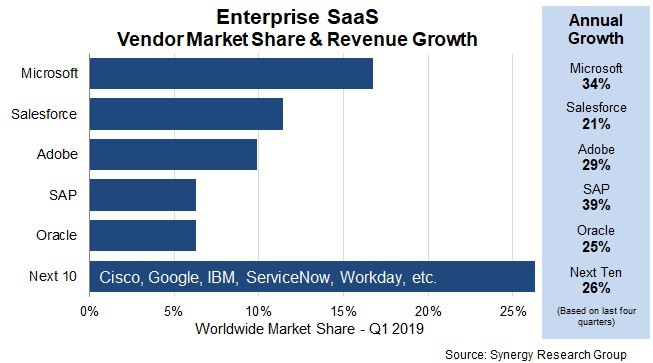
Image Source: Synergy.com
The installment, management, and upgrading of the software will be managed by the provider the users just have to store and analyze its own data.
Responsibility and Control of Azure in SaaS
- Azure IoT Suite
- Office 365 Suite
- Load balancing
- App Scaling
Now comes different types of cloud solutions.
Types of Cloud Solutions
Each service category can have the option to select private, public or hybrid cloud solutions.
Public Cloud
In the public cloud, the provider will serve its users’ access to their data center infrastructure. The user will have to pay as per the usage which will be counted by storage, CPU cycles or bandwidth they consume.
Private Cloud
With a private cloud, the user can host the applications on its own data center or intranet. The user will be the owner of the cloud ecosystem server, software, networking and platform resources. The user will be solely responsible to manage, update or upgrade the ecosystem.
Hybrid Cloud
In the hybrid cloud, the user will get the option to select a mix of private and public cloud solutions. The user will decide and manage the interactions of the two services. In this, the user will have to keep a constant eye on the security of the data. The reason being; data passes through the private and public both cloud setups.
Azure vs AWS vs Google Cloud Platform
We get this query a lot from our clients, in which one cloud computing platform is better as per their needs. When it comes to selecting the right cloud computing partner you need to understand the comparison of Azure vs AWS vs Google Cloud.
Hence; there is blog on a detailed comparison of each cloud computing platform.
Continue Read: Detailed Comparison of Azure vs AWS vs Google Cloud Platform(GCP)
How Microsoft Azure is Winning the race?
- Disaster Recovery
- Global Presence
- Scalability
- Amazing hybrid capabilities
- Seamless Integration and Continuity
- Automated updates
- Amazing Data Analytics
- Flexibility
There is no doubt that Microsoft has an intense portfolio and is winning the race of cloud vendors with almost 95 percent of fortune 500 companies.
Here are a few reasons why top enterprises and small startups are relying on Azure Cloud Consulting Services
1. Disaster Recovery
Azure has efficient options for data recovery and backups, secure the app data with encryption features. It also provides automatic recovery plans which help in retrieving the data in hours in outage or disaster scenario.
2. Global Presence
Azure infrastructure is available in more than 140 countries in 54 regions all over the world. The azure server is always ready whenever a business needs access.
This will help all kinds of businesses from a small startup to large enterprises get access from any geographical area.
3. Scalability
Scalability plays an important role in the capital of any business. Businesses usually keep costly hardware and networking connections to use at the time of the big hit.
During this waiting period, businesses waste a lot of capital. Azure solves the scalability problem with one click a business can get good resources anytime.
4. Amazing Hybrid Capabilities
The hybrid capabilities of Azure make it unique. Azure helps businesses achieve reliable consistent platforms and easy mobility between the public cloud and on-premise cloud.
5. Seamless Integration and Continuity
Microsoft Azure Cloud serves as a complete solution. The user will get all the essential tools under one umbrella like go live tools, unit testing, source control delivery or the integration testing tools.
6. Automated updates
The software updates in Azure are automated and real-time. Hence the user will get adapted infrastructure and applications. As a result; the businesses will grow faster and will have less carbon print.
7. Amazing Data Analytics
The built-in support of Azure for analyzing the data and deriving the insights will help in Cortana Analytics, Machine Learning, managed SQL services and Stream. Businesses get effective decision making support and new opportunities.
8. Flexibility
Azure provides excellent flexibility which allows the businesses to have functionality as per the requirement. The user will have the option to pay as much as they consume, they can accommodate the fluctuations in the business easily and switch to azure anytime. Bonus Section
AWS Cloud Data Migration Services
Azure is the preferred cloud computing platform because of its cloud data migrations. Azure provides different data migration services that help businesses migrate the data effectively.
There are two categories of migration services
- Online data transfer and hybrid cloud storage
- offline data migration to Amazon S3
Online data transfer and hybrid cloud storage
- These simple ways to create a network link to the VPC of the user, transfer the data to AWS, or use S3 for the hybrid cloud storage with the existing on-premises applications.
- Online data transfer helps in integrating existing process flows with the cloud storage like continuous data streams, backup or recovery. Also, it helps in lifting and shifting huge data sets for once.
Offline data migrations to Amazon S3
- With services like Amazon Snowball, Amazon Snowball edge, and Amazon Snowmobile businesses can transform the data as huge as 100 petabytes or 100 terabytes onto hard drives.
- The offline data migration services are beneficial in situations where data volume and bandwidth can not cross over your networks in the required desired time frame.
Over To YOU!
Cloud computing has become a necessity for every business today and Microsoft Azure Cloud is the leading choice for any startup or large enterprise.
We have tried our best to cover all the important aspects which a business needs to go for cloud computing services.
At Samarpan Infotech, our experts taking your business on the cloud. Our cloud computing services experts know how to seamlessly integrate Big Data services, Hadoop Development, BigQuery, NoSQL into your business model.
Get in touch with us today to transform your business with our proficient team of experts.
Related Azure Cloud Computing | Development Resources
With over 10 years of experience in Tech industry at Samarpan Infotech with architect system, problem solving and creativity. "Today is the only day. Yesterday is gone".