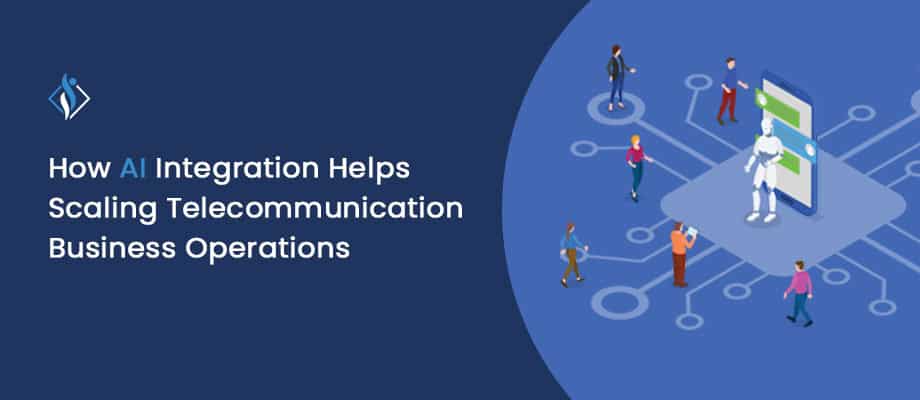
How AI Integration Helps Scaling Telecom Business Operations

A typical telecom operator handles over 100 million alarms per month, but only 5% are actionable, according to TM Forum. The result? Alert fatigue, delayed responses, and high operational costs.
Meanwhile, customer expectations keep rising. In a world where 60% of users expect issues to be resolved without contacting support, most telecoms are still buried in manual ticket triage, provisioning errors, and repeated field visits.
This is where AI automation comes in, from customer support and ticket triage to predictive maintenance and network optimization, AI is rapidly reshaping how telecom businesses monitor, manage, and grow their services.
The shift is already visible. Vodafone reported saving $500 million annually after implementing AI and automation across network operations and customer support. Meanwhile, Rakuten Mobile’s entirely cloud-native network leverages AI-driven observability and self-healing to operate at an unprecedented scale with leaner teams.
Why AI Automation Matters Now in Telecom Business Operations
Networks are growing in complexity with 5G rollouts, edge deployments, and hybrid cloud infrastructure, but most operational models haven’t kept pace. The traditional approach of throwing more people at more problems doesn’t scale when:
- Millions of alerts flood NOC systems, but less than 5% are actionable
- Tickets are misrouted or delayed due to manual triage
- Root cause analysis takes days, not minutes
- Technicians revisit the same site due to missed diagnostics
- Service activations fail because of system sync or order errors
- Congestion hotspots emerge from poor capacity forecasting
- Tower sites waste energy due to static power settings
- Billing mismatches cause revenue leakage
- SIM swap and roaming fraud evade real-time detection
- QoE (Quality of Experience) issues aren’t caught until customers churn
These are not hypothetical problems, they’re recurring pain points across nearly every tier-1 and tier-2 telecom operator.
According to GSMA Intelligence, 47% of AI deployments in telecom now target customer care, and 25% focus on network operations, revealing where the pressure is highest: high-volume, high-friction, high-cost processes.
Most NOC alerts are just noise, and teams spend too much time fixing avoidable problems. At the same time, costs are rising, and users expect faster, proactive service. AI automation is no longer optional, it’s the only way to handle modern networks at scale, cut operating costs, and meet today’s customer expectations.
10 Key Areas for AI Automation in Telecommunication Business
1. Monitoring & Early Warning
Network operations centers (NOCs) in telecom handle millions of alerts each month, the majority of which are false positives or redundant signals. This constant alert noise makes it difficult for teams to identify real issues promptly, resulting in service disruptions, delayed responses, and SLA violations.
AI-based monitoring systems can intelligently filter and correlate network events by analyzing historical data, topology, and real-time metrics. By recognizing patterns and anomalies, AI helps operations teams focus on critical incidents before they escalate into major outages.
How AI Automation Can Be Implemented in Monitoring
- Anomaly detection models: Deploy machine learning models to detect deviations from normal network behavior in real time.
- Event correlation engines: Consolidate related alarms into a single actionable incident using time, location, and network topology.
- Intelligent suppression rules: Automatically suppress alerts during known maintenance windows or based on historical low-impact behavior.
- Early warning risk scoring: Assign impact scores to anomalies based on affected customers, historical severity, and business risk.
- Dynamic threshold tuning: Continuously refine detection thresholds using feedback from incident response teams.
5 Benefits of Monitoring of Early Signs
- Reduced number of major incidents through early detection of critical signals.
- Faster Mean Time to Detect (MTTD), enabling quicker response and resolution.
- Significant reduction in false positives, improving NOC efficiency.
- Lower risk of SLA breaches due to more accurate and timely alerts.
- Improved operator focus and reduced fatigue from alert overload.
Example: BT Group implemented AI-driven event correlation and reduced alarm volume by over 50%, allowing its teams to detect and respond to serious network issues more effectively and with less operational noise.
2. Incident Triage & Prioritization
Telecom support centers often deal with a high volume of incoming tickets, many of which are misclassified or assigned out of order. Manual triage leads to delays, inconsistent severity assessments, and situations where low-impact issues are resolved before critical ones, resulting in SLA breaches and frustrated customers.
AI-powered triage systems analyze ticket content, past incident data, and real-time network conditions to assess impact and urgency. These systems automatically prioritize and route tickets to the right teams, ensuring that high-severity incidents are handled first, and resource allocation is optimized.
How to Implement AI Automation in Triage Prioritization
- Natural language processing (NLP): Use NLP models to classify ticket descriptions and extract relevant metadata such as device, location, and error type.
- Impact analysis algorithms: Assess severity based on factors like affected service types, customer tier, or geographic scope.
- Historical resolution models: Train AI using past incident data to predict escalation risk and assign urgency levels.
- Auto-assignment engines: Route tickets to the appropriate teams or individuals based on expertise, availability, and impact.
- Adaptive prioritization logic: Continuously refine triage rules and severity scoring based on ticket outcomes and resolution timelines.
4 Benefits of AI-powered Triage Prioritization
- Faster handling of high-impact incidents, reducing downtime for critical services.
- Reduced manual triage effort, allowing teams to focus on resolution instead of classification.
- Decreased ticket backlog by deferring or resolving low-priority issues automatically.
- Improved customer satisfaction due to quicker resolution of the most disruptive problems.
3. Root-Cause Discovery & Decision Support
When service issues arise in telecom networks, identifying the true root cause can take hours or even days especially when symptoms span multiple layers like access, transport, and core. Without clear visibility, teams often apply temporary fixes or escalate prematurely, increasing resolution time and operational cost.
AI systems accelerate root-cause analysis by correlating real-time signals with historical incident patterns. They can pinpoint the likely fault domain and recommend the most effective remediation steps based on prior outcomes, turning hours of manual investigation into actionable insights in minutes.
How AI Automation Can Be Implemented in Fault Detection
- Multi-domain correlation engines: Analyze data across RAN, transmission, and core layers to isolate the fault location automatically.
- Pattern-matching algorithms: Compare current symptoms against historical incidents to identify recurring fault signatures.
- Next-best-action prediction: Recommend resolution steps based on previous successful interventions for similar issues.
- Context-aware diagnostics: Factor in customer impact, geography, and asset history to refine root-cause hypotheses.
- Human-in-the-loop validation: Enable engineers to review, adjust, and approve AI-suggested root causes before execution.
5 Benefits of Automated Fault Detection
- Mean Time to Resolve (MTTR) reductions ranging from 20% to over 50%.
- Fewer escalations and repeat tickets by resolving the true underlying issue.
- Reduced dependency on senior engineers for complex diagnostic tasks.
- Lower operational cost by avoiding unnecessary field visits or system resets.
- Improved service reliability and customer trust through permanent issue resolution.
4. Workflow Automation & Approvals
Many operational tasks in telecom, like updating tickets, requesting approvals, or generating compliance reports, are still performed manually. These repetitive steps slow down processes, introduce errors, and create bottlenecks across service delivery, maintenance, and customer support workflows.
AI-driven automation streamlines these workflows by handling routine actions automatically, while ensuring that critical steps involving compliance or risk remain under human control. This results in faster throughput, fewer manual errors, and consistent process execution at scale.
How AI Can Be Implemented in Workflow Automation
- Robotic Process Automation (RPA): Use RPA bots to perform repetitive tasks such as ticket updates, status changes, and report generation.
- Approval workflow engines: Automate approval routing based on pre-defined rules, urgency, and team structure.
- Case management automation: Auto-fill case data, attach diagnostics, and close resolved tickets with audit trails.
- Exception handling triggers: Detect when workflows stall (e.g., waiting on input or overdue) and prompt corrective actions.
- Compliance-aware automation rules: Ensure that AI-driven actions adhere to internal controls and regulatory policies.
5 Benefits of AI-powered Workflow Automation
- Faster service operations through automation of routine steps and approvals.
- Lower operational errors due to reduced manual data entry and handoffs.
- Improved compliance tracking with full auditability of automated decisions.
- Reduced workload on operations staff, freeing them to handle complex cases.
- 15% more consistent execution of standard processes across teams and regions.
5. Service Quality & Customer Experience Management
Telecom operators often discover service issues only after customers complain. Traditional monitoring focuses on technical metrics, while the actual user experience (call drops, buffering, latency) is harder to measure in real time. This gap leads to reactive support, poor Net Promoter Scores (NPS), and early-life churn.
AI bridges the gap between network performance and customer experience by correlating technical signals with customer-level impact. It enables proactive identification of experience degradation, predicts potential churn, and recommends interventions before the customer ever reports an issue.
How AI Automation Can Be Implemented in CX Management
- Customer impact correlation models: Map network events to affected customers and prioritize by segment or SLA.
- QoE analytics engines: Monitor session-level data (voice, video, data) to flag drops in quality across services.
- Experience anomaly detection: Use behavioral baselines to detect sudden shifts in usage or interaction patterns.
- Churn risk prediction: Analyze usage trends, complaint history, and network quality to score likelihood of customer churn.
- Automated CX interventions: Trigger proactive alerts, plan adjustments, or support actions when high-value customers are impacted.
5 Benefits of AI in CX
- Improved customer satisfaction through faster, proactive issue resolution.
- Reduced complaints per 1,000 subscribers and fewer inbound support calls.
- Lower churn rates driven by early detection of service degradation.
- Better NPS and customer retention across competitive markets.
- Stronger brand reputation by avoiding large-scale outages going unnoticed.
6. Predictive Maintenance & Prevention
Traditional maintenance in telecom is reactive or scheduled based on fixed intervals, regardless of actual equipment condition. This often results in either unnecessary service visits or unplanned outages due to late detection of deteriorating infrastructure, especially remote towers and power systems.
AI enables telecom operators to shift from reactive to predictive maintenance by analyzing sensor data, fault logs, and environmental inputs to forecast failures before they occur. This allows teams to intervene at the optimal time, reducing downtime, emergency work, and cost.
How AI Automation Can Be Implemented in Maintenance
- Sensor-based failure prediction: Analyze data from batteries, generators, radios, and power units to predict degradation trends.
- Anomaly-based health monitoring: Flag deviations in equipment performance metrics like voltage, temperature, or fuel usage.
- Maintenance scheduling optimization: Recommend intervention timing based on failure likelihood and resource availability.
- Asset history correlation: Combine past repair logs and site characteristics to model failure patterns.
- Truck-roll avoidance logic: Suggest remote fixes or resets for issues previously resolved without field dispatch.
5 Benefits of Automated Maintenance
- 30% Fewer unplanned outages due to early detection of component failure.
- Reduced emergency maintenance costs and fewer after-hours escalations.
- Optimized use of field resources by avoiding unnecessary site visits.
- Higher uptime across remote and rural sites with limited redundancy.
- Longer asset life through condition-based servicing instead of fixed cycles.
7. Workforce Productivity (Field and Back Office)
Telecom operations often suffer from fragmented scheduling systems, inconsistent workload distribution, and manual coordination between field teams and back-office staff. This results in underutilized technician hours, repeated site visits, and delays in service fulfillment or fault repair.
AI improves workforce productivity by intelligently assigning tasks, optimizing routes, and balancing workloads across available staff. It ensures the right technician with the right skills and parts is dispatched at the right time, while automating back-office processes like ticket updates and documentation.
How AI Automation Can Be Implemented
- Skill-based task matching: Assign field jobs based on technician expertise, certifications, and past performance.
- AI-driven route optimization: Plan travel paths using traffic, distance, and job urgency to minimize travel time.
- Real-time rescheduling engines: Reassign jobs dynamically when delays, cancellations, or emergencies occur.
- Back-office task automation: Auto-complete repetitive actions like status updates, documentation, and checklists.
- Resource load forecasting: Predict daily/weekly task volumes to allocate teams more efficiently across regions.
5 Benefits of Automated Task Assignment
- Higher number of completed jobs per technician per day.
- Fewer missed or delayed appointments due to better planning.
- Lower operational cost from optimized resource usage and routing.
- Reduced repeat visits and increased “first-time-right” success rates.
- Improved team morale with more balanced workload distribution.
8. Process Exception Handling (Fallout Management)
Telecom service processes, like activation, provisioning, and billing, are complex, involving multiple systems and handoffs. When these processes break down, orders get stuck, activations fail, and customers face long delays. These “fallouts” are often detected late and require manual intervention to fix, increasing costs and churn risk.
AI can monitor end-to-end workflows in real time to detect when processes stall, identify common failure points, and even auto-correct known errors. This ensures smoother service delivery and significantly reduces the need for manual rework.
How AI Automation Can Be Implemented in Exception Handling
- Order flow monitoring engines: Track the status of activation, provisioning, and billing processes across integrated systems.
- Stuck process detection models: Identify patterns where and why orders or requests are failing.
- Auto-remediation logic: Trigger corrective actions like data correction, retry commands, or workflow restarts for known issues.
- Exception categorization: Group fallouts by root cause to prioritize systemic fixes or flag integration gaps.
- Feedback-driven learning loops: Improve fallout detection and response by learning from historical recovery outcomes.
5 Benefits of AI-powered Exception Handling
- Faster order fulfillment and shorter activation cycles across services.
- Reduced fallout rates and manual rework in provisioning and billing.
- Improved customer satisfaction by resolving issues before escalation.
- Lower support costs through automation of common exception scenarios.
- Better process transparency for operations and IT teams.
9. Demand Forecasting & Resource Optimization
Telecom networks must balance performance, cost, and future demand across a vast infrastructure footprint. Yet, many operators still rely on static forecasts, siloed planning teams, and reactive upgrades. This leads to overbuilds in low-traffic areas, congestion in high-growth zones, and inefficient use of capital and inventory.
AI transforms planning by analyzing usage trends, forecasting demand, and optimizing capacity, spectrum, and budget allocation. It allows operators to anticipate where and when to invest and where to hold back based on real-time and predictive insights.
How AI Automation Can Be Implemented in Demand Forecasting
- Traffic forecasting models: Predict bandwidth demand across cells, regions, or service types using historical and seasonal trends.
- Capacity planning engines: Simulate future network loads and recommend upgrades or offloading strategies.
- Inventory optimization algorithms: Forecast spare part requirements and prevent overstock or shortages at regional warehouses.
- Customer-segment-based investment modeling: Prioritize infrastructure investment based on user density, churn risk, or revenue contribution.
- CapEx (Capital Expenditure) efficiency scoring: Identify projects with the highest return on investment (ROI) using AI-based scoring frameworks.
5 Benefits of AI-Powered Demand Forecasting
- Reduced congestion and service degradation in high-growth zones.
- Higher capital efficiency through targeted upgrades and delayed overbuilds.
- 25% reduction in inventory waste.
- Improved accuracy in budget planning and investment timelines.
- Stronger alignment between network growth and customer demand.
10. Risk, Security & Financial Leakage Control
Telecom operators face constant exposure to fraud, revenue leakage, and security risks, from SIM swaps and roaming abuse to unbilled usage and policy violations. Manual audits often miss subtle anomalies, and reactive detection means losses are discovered only after damage is done.
AI enables real-time detection of financial and security risks by analyzing transaction patterns, behavior anomalies, and system logs. It can flag fraud attempts, correct billing inconsistencies, and enforce policy compliance across vast volumes of data at machine speed.
How AI Automation Can Be Implemented in Fraud Detection
- Fraud detection models: Use machine learning to identify SIM swap fraud, international call anomalies, or repeated failed authentications.
- Revenue assurance analytics: Cross-validate usage data, billing records, and CRM entries to find gaps or mismatches.
- Real-time risk scoring engines: Assign dynamic risk levels to high-value transactions or suspicious activities.
- Policy violation monitors: Detect configuration changes, account abuse, or internal misuse of credentials.
- Auto-correction and alerting tools: Trigger immediate remediation steps or notify security/compliance teams on confirmed anomalies.
5 Benefits of AI-powered Fraud Detection
- Lower revenue leakage through early detection of billing and rating errors.
- 60% faster fraud detection and response, reducing financial exposure.
- Improved compliance with internal policies and regulatory mandates.
- Reduced manual audit effort and faster closure of investigations.
- Stronger customer trust through enhanced security and billing transparency.
Quick Summary of AI Automation Use Cases, Outcomes, and KPIs
| AI Use Case | Operational Problem Solved | Key KPIs to Track |
|---|---|---|
| Monitoring & Early Warning | Filters out noise and correlates related alerts to detect real issues faster | Alarm volume ↓ False alerts ↓ MTTD ↓ Major incidents ↓ |
| Incident Triage & Prioritization | Focuses teams on customer-impacting issues and accelerates routing | High-severity tickets handled ↑ Queue time ↓ SLA breaches ↓ |
| Root-Cause Discovery & Decision Support | Pinpoints fault domain and suggests next-best-action | MTTR ↓ Repeat incidents ↓ Escalations ↓ First-time fix ↑ |
| Workflow Automation & Case Management | Reduces manual handling by automating ticket updates and routing | Tickets per agent ↑ Reassignment rate ↓ Time-to-assign ↓ Backlog size ↓ |
| Service Quality & Customer Experience | Links network events to customer impact and enables proactive response | Complaints per 1K subs ↓ Churn ↓ Trouble calls ↓ NPS ↑ QoE score ↑ |
| Predictive Maintenance & Prevention | Predicts failures and schedules timely intervention | Outage minutes ↓ Emergency dispatches ↓ Preventable failures ↓ Planned vs unplanned work ↑ |
| Controlled Operational Automation | Enables safe, self-healing actions with rollback capability | Auto-resolved cases ↑ MTTR ↓ Rollback rate ↓ Change failure rate ↓/stable |
| Workforce Productivity & Scheduling | Optimizes field tech dispatch, load balancing, and job routing | Jobs per tech per day ↑ Repeat visits ↓ Truck rolls per fault ↓ On-time arrival ↑ |
| Process Exception Handling (Fallout) | Detects and corrects failures in provisioning, activation, or billing | Fallout rate ↓ Activation cycle time ↓ First-time-right % ↑ Early-life churn ↓ |
| Planning & Resource Optimization | Forecasts demand and aligns capacity planning with real usage | Congestion incidents ↓ Utilization balance ↑ Cost per improved user ↓ CapEx ROI ↑ |
| Risk, Security & Financial Leakage Control | Detects fraud, billing errors, and revenue leakage in real time | Revenue leakage ↓ Fraud loss ↓ False positives ↓ Time-to-detect ↓ |
4. AI Implementation Models for Telecom Operations
- Assisted Automation (Human-in-the-Loop): AI provides recommendations, but human operators make the final decision before action. This model works well for triage, root-cause analysis, and compliance-sensitive workflows where oversight is essential.
- Semi-Autonomous Operations: AI handles routine, low-risk tasks automatically, while escalating uncertain or high-impact cases to human teams. It’s ideal for automating alert suppression, ticket updates, and basic energy optimizations.
- Fully Autonomous Execution: AI independently monitors, analyzes, and executes end-to-end actions without human involvement. This approach powers real-time self-healing, traffic rerouting, and automated fault remediation in advanced networks.
- AI as-a-Service (Platform-Based Integration): Operators integrate AI capabilities via external platforms or APIs instead of building models internally. Common use cases include fraud detection, AIOps-driven monitoring, and predictive maintenance.
6 Challenges Telecom Operators Must Address Before AI Automation
- Siloed OSS (Operational Support Systems)/BSS (Business Support Systems) and NOC data: Telecom data is fragmented across systems that don’t talk to each other, making AI training difficult.
- Complex, manual ticketing flows: Incident triage and routing processes are often customized and inconsistent, limiting automation readiness.
- Legacy network infrastructure: Older OSS/BSS platforms lack APIs and real-time data feeds needed for AI integration.
- Lack of rollback controls in network automation: Automating changes to live network elements without built-in safeguards poses major operational risks.
- Delayed detection of service-impacting faults: Without real-time correlation between network performance and customer experience, AI can’t prioritize effectively.
- Inconsistent topology and inventory data: Mismatch between logical and physical network elements makes it hard for AI to localize faults or optimize routing.
Conclusion
Telecom operators can no longer scale with manual workflows and fragmented systems. As networks evolve, AI integration is becoming essential to reduce false alerts, prevent outages, automate resolutions, and improve customer experience.
From real-time triage to predictive maintenance, AI is already driving measurable impact across global telecom leaders. But success depends on choosing the right use cases, models, and partners.
Samarpan Infotech works with telecom providers to design, deploy, and implement AI integration across NOC, OSS, BSS, and field operations. With deep expertise in infrastructure, cloud platforms, and AI integration, it helps operators turn use cases into outcomes.
With over 10 years of experience in Tech industry at Samarpan Infotech with architect system, problem solving and creativity. "Today is the only day. Yesterday is gone".