How AI Integration Can Help marketing & Advertising Scale Operations

Marketing and advertising today operate in an environment defined by speed, fragmentation, and rising expectations. Brands are no longer competing on creativity alone; they are competing on how quickly they can adapt, personalize, and optimize across dozens of channels. What once worked as a quarterly campaign cycle now demands real-time responsiveness and continuous experimentation.
As organizations grow, the real challenge is not launching campaigns, it is scaling operations without losing control. Data multiplies, workflows become more complex, and teams feel stretched between execution and strategy. This is where AI integration becomes a strategic enabler. Not as a shortcut or gimmick, but as a structured way to build smarter systems that support sustainable, scalable marketing performance.
Why AI Automation Matters Now in Marketing & Advertising Operations
Marketing has become too complex to run manually at scale. Most teams now juggle dozens of channels, tools, and data sources, yet a large share of time still goes into repetitive work, pulling reports, cleaning data, updating segments, resizing creatives, and reacting to performance drops.
At the same time, expectations have increased. Personalization is no longer optional, Salesforce reports 73% of customers expect brands to understand their unique needs. But doing that manually across email, ads, web, and CRM is unrealistic. Add rising media costs and privacy-driven targeting changes, and the margin for error gets even smaller.
AI automation fills this gap by turning marketing into a real-time system. It can continuously detect performance anomalies, refresh segments based on behavior, optimize bids and budgets, generate creative variations faster, and summarize insights in plain language.
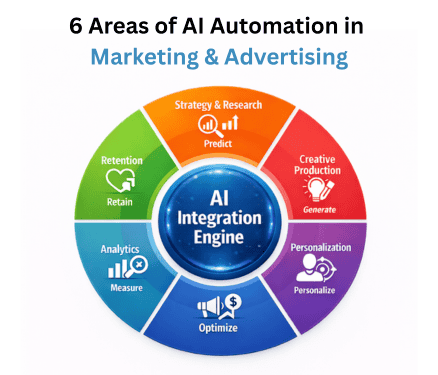
6 Ways to Integrate AI in Marketing and Advertising
1. Strategy and Research
Marketing strategy often relies on fragmented data. Audience research is pulled from GA4, CRM exports, ad platform dashboards, and survey results. By the time insights are compiled, the market has shifted.
AI-driven research engines can cluster behavior patterns, identify emerging trends, and uncover intent signals automatically. Instead of static personas, marketing teams get dynamic audience intelligence.
How AI Automation Can Be Implemented in Strategy and Research
- Behavior clustering from multi-source data: Integrate CRM, GA4, and ad data to automatically group users by lifecycle stage, value, and behavior patterns.
- AI-powered sentiment analysis: Analyze reviews, social comments, and survey responses to identify emerging pain points and trends.
- Predictive trend detection: Use machine learning models to identify rising search queries and content themes before competitors react.
- Automated competitor monitoring: Deploy NLP models to track competitor ads, messaging changes, and positioning shifts.
- Customer journey mapping automation: Use AI to analyze touchpoints and identify drop-off patterns across funnels.
5 Benefits of Automating Strategizing
- Faster strategy decisions backed by real audience signals, not guesswork.
- Sharper targeting because segments reflect how people actually behave.
- Less manual research time spent on exports, reports, and spreadsheets.
- Earlier spotting of content angles and product demand before competitors.
- Personas that stay updated continuously, not a once-a-year document.
7 AI Tools to Help in Strategy and Research
| No | AI Tools | What it can do |
|---|---|---|
| 1 | HubSpot | Automates lifecycle segmentation and triggers campaigns based on lead/customer actions. |
| 2 | Salesforce (Einstein AI) | Predicts conversion likelihood and supports pipeline/revenue forecasting. |
| 3 | Mixpanel | Visualizes funnels and cohorts to see how users move from interest to conversion. |
| 4 | Sprinklr | Monitors social conversations at scale and summarizes sentiment and key themes. |
| 5 | Brandwatch | Detects trends and conversation shifts so you can spot demand and issues early. |
| 6 | SEMrush | Tracks competitor keywords, ads, and messaging to guide faster strategy moves. |
| 7 | Tableau | Turns scattered marketing data into dashboards with faster insight discovery. |
2. Creative and Content Production
Creative teams are under pressure to produce more, faster, platform-specific versions, multiple ad variations, and fresh headlines for A/B tests. The same idea also has to work in both short-form and long-form formats, so a lot of time gets lost in resizing, rewriting, and repurposing instead of creating.
AI can act like a creative co-pilot, drafting multiple copy and headline options, adapting creatives to each platform’s specs, and suggesting messaging tweaks based on what’s getting clicks and conversions. Over time, it helps you produce better variations faster, without relying on guesswork.
How to AI in Content Production
- Creative variation generation: Use generative AI to produce multiple headline and copy variations for testing.
- Automated image and video resizing: AI tools adjust creative formats automatically for different platforms.
- Performance-based copy optimization: Train AI models on past campaign data to generate high-converting messaging.
- Brand voice reinforcement engines: Build custom AI models trained on brand guidelines to ensure consistency.
- Content repurposing automation: Convert blog content into email snippets, social captions, and ad hooks.
5 Benefits of AI Content Creation
- Produce more variations in less time, speeding up content cycles significantly.
- Reduce creative burnout by cutting repetitive resizing and rewriting work.
- Test more headlines, hooks, and formats at once for stronger A/B learning.
- Keep messaging consistent by applying brand voice rules across every asset.
- Adapt faster to platform shifts by generating and refreshing creatives quickly.
5 AI Tools to Help in Content Production
| No | Tool | What it does |
|---|---|---|
| 1 | OpenAI (ChatGPT) | Generates marketing copy, headline options, hooks, scripts, and content rewrites quickly. |
| 2 | Jasper | Built for marketers to produce on-brand ad copy, blogs, and campaign messaging at scale. |
| 3 | Canva | Uses AI to create designs and instantly resize assets for different platforms and placements. |
| 4 | Adobe (Firefly) | Generates and edits images with AI while fitting into Adobe’s creative workflow. |
| 5 | Copy.ai | Generates ad copy, landing page text, and social captions with fast variation building. |
3. Personalization at Scale
Personalization has become the default expectation, but many campaigns still treat everyone the same. When a first-time visitor and a ready-to-buy repeat customer see identical ads and emails, relevance drops, costs rise, and high-intent opportunities slip through.
AI-driven personalization engines automatically tailor messaging, offers, and creative based on real-time behavior, what someone browses, clicks, abandons, or returns to, so each customer sees the most relevant next step, not a generic campaign
Amazon attributes up to 35% of its revenue to recommendation engines, a strong signal of personalization power.
How AI Automation Can Be Implemented in Personalization
- Dynamic email personalization: Automatically customize subject lines, offers, and content blocks based on behavior.
- Website content personalization: Serve dynamic homepage banners based on visitor lifecycle stage.
- Predictive product recommendations: Use recommendation algorithms to show relevant services or products.
- Behavior-triggered campaigns: Trigger automated sequences based on user activity patterns.
- Churn prediction modeling: Identify at-risk customers using behavioral signals.
4 Benefits of Personalizing Experiences
- Higher conversion rates because messaging and offers match real intent.
- Increased customer lifetime value by driving repeat purchases and deeper engagement.
- Lower churn by catching drop-off signals early and acting before customers leave.
- Smarter cross-sell and upsell by recommending relevant add-ons based on behavior.
8 AI Tools to Help in Personalization
| No | AI tool | What it can do |
|---|---|---|
| 1 | Dynamic Yield | Personalizes on-site experiences in real time based on visitor behavior and intent. |
| 2 | Optimizely | Runs experiments and personalization to improve conversion with data-backed tests. |
| 3 | Salesforce (Marketing Cloud) | Orchestrates personalized journeys across email, mobile, and web touchpoints. |
| 4 | Adobe (Experience Cloud) | Uses AI to deliver recommendations and personalized content at scale. |
| 5 | Klaviyo | Triggers personalized email/SMS flows based on shopping and engagement behavior. |
| 6 | Bloomreach | Powers product/content recommendations and personalized commerce experiences. |
| 7 | Insider | Personalizes messaging and experiences across web, app, email, and ads. |
| 8 | Braze | Drives multi-channel personalization and engagement using lifecycle signals. |
4. Media Buying and Optimization
Media budgets keep climbing, but manual bid changes and audience tweaks are slow and reactive. By the time a team spots a performance dip, days of spend may already be wasted on the wrong segments, placements, or creatives.
AI connects with ad platforms to automate bidding, refine audience targeting, and shift budgets in real time. Instead of waiting for weekly reviews, it reacts to performance signals quickly, moving spend toward what’s working and pulling back from placements wasting budget.
How to Automate Bid Optimization with AI
- Predictive bid management: Use ML models to adjust bids based on predicted conversion likelihood.
- Budget reallocation engines: Automatically shift budget toward high-performing channels.
- Fraud detection systems: Identify invalid traffic patterns in real time.
- Creative fatigue detection: Monitor CTR decline patterns and trigger creative refresh alerts.
- Cross-platform attribution modeling: Use AI-based multi-touch attribution to identify real performance drivers.
4 Benefits of Automated Media Buying
- Lower cost per acquisition by reducing wasted spend on low-performing audiences and placements.
- Faster optimization cycles because decisions happen daily (or hourly), not after weekly reviews.
- Stronger ROI visibility with clearer links between spend, leads, and revenue outcomes.
- Smarter budget allocation by automatically shifting spend toward what’s performing best.
7 AI Tools to Automate Bidding
| No | AI tool | What it can do |
|---|---|---|
| 1 | Google Ads | Automates bidding and targeting with smart signals to improve conversions and CPA. |
| 2 | Meta (Ads Manager) | Uses AI to optimize delivery, audiences, and placements across Meta platforms. |
| 3 | The Trade Desk | AI-driven programmatic buying with advanced targeting and optimization controls. |
| 4 | Adobe (Advertising Cloud) | Manages and optimizes cross-channel campaigns with unified performance insights. |
| 5 | Smartly.io | Combines creative automation with media optimization for faster performance scaling. |
| 6 | Criteo | Uses AI to optimize commerce-focused ads and retargeting across networks. |
| 7 | Albert | Automates media buying decisions using AI to optimize spend and outcomes. |
5. Measurement and Analytics
Marketing data is scattered across ads, CRM, email, and analytics tools, so reporting becomes a manual exercise. When numbers don’t match, teams end up debating attribution instead of improving performance, slowing decisions and making ROI harder to defend.
AI-powered analytics pulls data into one view, spots patterns humans miss, and flags anomalies early. Instead of static dashboards that explain yesterday, it predicts what’s likely to happen next, highlighting which channels, audiences, or creatives need attention before results slip.
How AI Automation Can Be Implemented in Analytics
- Unified data lake integration: Consolidate CRM, ads, email, and web analytics into a single AI-ready environment.
- Automated anomaly detection: Identify performance spikes or drops automatically.
- Predictive revenue modeling: Forecast campaign outcomes based on historical trends.
- Natural language reporting dashboards: Allow executives to query data conversationally.
- Automated KPI storytelling: Generate weekly performance summaries automatically.
4 Benefits of AI-powered Analysis
- Reduced manual dashboard work by automating data pulls and KPI updates.
- Improved forecasting accuracy by using past patterns to predict likely outcomes.
- Stronger data-driven culture because decisions rely on signals, not opinions.
- Clearer ROI justification by connecting spend directly to pipeline, revenue, or retention
4 AI Tools for Measurement and Analytics
| No | AI tool | What it can do |
|---|---|---|
| 1 | Google Analytics | Provides predictive insights and behavior reporting across your site/app traffic. |
| 2 | Tableau | Turns complex marketing data into visual dashboards with faster insight discovery. |
| 3 | Datorama | Unifies marketing performance data and supports cross-channel attribution views. |
| 4 | Amplitude | Deep behavioral analytics to understand product and campaign impact on users. |
6. Customer Experience and Retention
Customer acquisition is getting more expensive, so retention is becoming the smarter growth lever. Keeping existing customers engaged, reducing churn, and increasing repeat purchases often delivers more predictable returns than constantly paying to replace lost customers.
AI-powered engagement engines spot early churn signals, tailor messages to each customer’s behavior, and trigger the right retention actions automatically, like win-back emails, support prompts, or targeted offers, so you intervene before customers drift away, not after they’re gone.
How AI Automation Can Be Implemented in Customer Retention
- AI chat and voice assistants: Provide instant, intelligent responses across channels.
- Sentiment-based ticket prioritization: Automatically identify high-risk customer complaints.
- Retention offer automation: Trigger personalized incentives for at-risk customers.
- Feedback mining engines: Analyze surveys and reviews for recurring issues.
- Lifecycle campaign orchestration: Automate re-engagement based on inactivity signals.
4 Benefits of AI-powered Customer Retention
- Higher retention rates by re-engaging customers before they drop off.
- Reduced support costs by deflecting routine questions and speeding up ticket handling.
- Stronger brand loyalty through more responsive, personalized experiences.
- Increased lifetime value as customers stay longer and buy more over time.
5 AI Tools for Customer Retention
| No | AI tool | What it can do |
|---|---|---|
| 1 | Intercom | AI chat and messaging that deflects tickets and improves customer response speed. |
| 2 | Braze | Lifecycle engagement campaigns across push, email, SMS, and in-app channels. |
| 3 | Gainsight | Predicts churn and manages customer success workflows for retention. |
| 4 | Qualtrics | Captures and analyzes customer feedback to improve experience and reduce churn. |
| 5 | HubSpot | Automates lifecycle nurturing and customer communication based on behavior. |
Conclusion
AI integration in marketing isn’t about replacing people, it’s about removing friction. It helps when data is scattered across tools, teams are stuck in manual tasks, personalization is hard to scale, media budgets need tighter control, and retention becomes reactive. With the right setup, AI adds structure and intelligence to workflows, turning marketing from “react and report” into “predict and improve.”
At Samarpan Infotech, we help marketing and advertising teams identify high-impact automation opportunities, implement AI integration across analytics, CRM, ad platforms, and content workflows, and build scalable campaign operations that improve speed, performance, and ROI.
With over 10 years of experience in Tech industry at Samarpan Infotech with architect system, problem solving and creativity. "Today is the only day. Yesterday is gone".