How AI Integration Can Help Education and Training Businesses Scale Operations
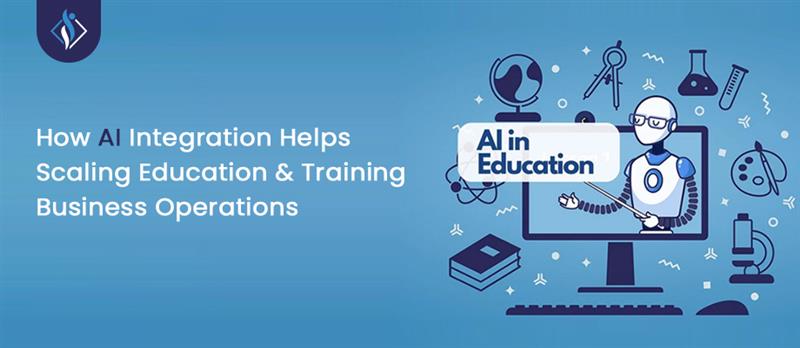

The global market for AI in education was valued at over $5.88 billion in 2024 and projected to reach $32.27 billion by 2030, according to Grand View Research. This growth isn’t speculative, it reflects how rapidly educational institutions and training providers are deploying AI to improve outcomes and efficiency.
From traditional classrooms to modern online academies, the demand for more personalized, scalable, and efficient learning experiences has never been higher.
But it’s not just about learning. Behind every lesson is a complex web of operations: scheduling, content creation, student engagement, marketing, compliance, support, and analytics. These processes, many of them manual and repetitive, are ripe for disruption.
AI integration is now emerging as the key enabler for education and training businesses to automate low-value tasks, deliver personalized experiences at scale, reduce operational costs, and unlock new business models.
This blog explores how AI is not just a trend but a practical lever for scaling growth across every aspect of an education or training organization. Whether you’re a corporate L&D provider, an edtech startup, or a traditional school adapting to hybrid models, this guide will show you where to start and what to expect.
Why AI Automation Matters Now in Education and Training Business Operations
Education and training businesses are under growing pressure to scale, personalize, and modernize, all at once. At the same time, staff bandwidth and budgets haven’t kept pace. AI isn’t a futuristic luxury anymore. It’s becoming the operational backbone for institutions trying to stay competitive.
- Manual Processes Are Slowing Down Growth: Too many organizations rely on spreadsheets, emails, and siloed systems to manage learners, programs, and operations. It leads to burnout, delays, and poor learner experiences.
- Learners Expect More & Faster: Today’s learners want personalized learning paths, instant feedback, and on-demand support. Meeting those expectations manually doesn’t scale. AI enables real-time adaptation at every stage of the learner journey.
- Margins Are Tighter Than Ever: With rising operational costs and growing competition, education businesses need ways to scale without adding headcount. AI brings efficiency across marketing, sales, content, and support, helping you serve more learners without growing your overhead.
In short, AI is not about replacing educators or trainers, it’s about amplifying what they can do. The next sections break down the most valuable automation opportunities, one by one.
7 Key Areas for AI Automation in Education and Training Business
1. Automating Administrative & Operational Tasks
Administrative overhead remains one of the largest hidden costs in education and training businesses. From managing enrollments to updating course rosters, these repetitive tasks drain staff time and increase the likelihood of human error.
A McKinsey study found that educators and training professionals spend up to 40% of their time on non-teaching tasks, significantly impacting productivity and learner engagement.
AI automation can take over repetitive back-office workflows like student data entry, attendance tracking, and compliance documentation, allowing your team to shift focus to more strategic, learner-facing work.
How to Implement AI for Administrative Tasks
- AI-powered scheduling assistant: Use natural language processing (NLP) to automate meeting/class scheduling based on availability across calendars.
- OCR to process forms and documents: Automate data extraction from registration forms, ID scans, and attendance sheets.
- RPA bots for student record updates: Robotic Process Automation (RPA) can sync data across your LMS, CRM, and finance systems in real time.
- Smart email routing: AI can triage and route incoming emails to the right department (e.g., billing, support, academic queries).
- AI workflow triggers in LMS/HRIS: Set up triggers that initiate alerts, updates, or tasks based on predefined conditions (e.g., incomplete onboarding, failed payment).
5 Benefits of Operational Automation
- 80-90% reduction in manual data entry
- Faster response times to student or staff requests, improving operational efficiency.
- Lower administrative costs per learner without expanding headcount.
- Fewer errors in record-keeping, reducing compliance risk.
- Staff focus shifts to higher-value tasks like program improvement or learner engagement.
2. Personalized Learning at Scale
Delivering truly personalized learning experiences has always been the goal, but historically, it’s been expensive and labor-intensive. Creating tailored paths for each learner requires real-time data, content adjustments, and constant monitoring something human instructors alone cannot scale.
In 2023 survey, 86% of students said personalization positively impacts their learning outcomes, yet most institutions still offer a one-size-fits-all model due to limited resources.
AI enables scalable personalization by dynamically adjusting content, pace, and support based on each learner’s behavior, performance, and preferences, without increasing teaching staff workload.
How to Implement AI in Personalize Learning Journeys
- AI-based adaptive learning engines: Systems adjust difficulty, topic sequencing, and content format in real time based on learner performance.
- Recommendation algorithms for content: Like Netflix, AI suggests next-best modules, videos, or quizzes tailored to individual learning goals.
- Natural language processing for learner profiling: NLP can analyze written assessments or feedback to detect learner sentiment and adapt accordingly.
- Intelligent pacing tools: AI monitors learner engagement and offers time extensions or quick reviews based on fatigue or high performance.
- Microlearning personalization: AI auto-generates or selects short, contextually relevant learning nuggets suited to a learner’s current level.
5 Advantages of Personalization with AI
- Higher learner engagement through content that feels personally relevant and appropriately challenging.
- Up to 30% improvement in course completion rates.
- Reduction in dropouts, especially in online and self-paced programs.
- Improved knowledge retention with individualized review cycles.
- Instructor workload remains stable, even as learner volume scales.
3. Enhancing Content Creation & Course Development
Developing high-quality training content takes time, subject-matter expertise, and constant updates. Many education providers struggle to keep pace with evolving learner needs, regulatory changes, or market trends, resulting in outdated materials or generic modules that fail to engage.
According to the 2023 Training Industry Report, content development accounted for 17% of total training spend in the U.S., alongside LMS (17%) and authoring tools (12%). This reflects the ongoing challenge of balancing quality content creation with operational efficiency amid $101 billion in total U.S. training investment.
AI tools can accelerate content creation by assisting with everything from generating lesson drafts to repurposing existing materials into new formats, cutting production cycles from weeks to hours without compromising instructional value.
How AI is Implemented to Accelerate Content Development
- AI copy generation for course outlines: Use large language models (LLMs) to generate lesson plans, module descriptions, and learning objectives based on course goals.
- Automatic video captioning and summarization: Tools like Whisper or Descript create accessible content from raw video/audio, including highlights and quizzes.
- Content repurposing engines: AI can turn long-form materials (e.g., whitepapers or lectures) into bite-sized lessons, infographics, or assessments.
- Real-time plagiarism checks and readability scoring: Ensure content originality and learner-appropriate tone using AI-based review layers.
5 Benefits of AI in Content Creation
- Cut course development time by 50-70%, based on industry benchmarks using AI writing and design assistants.
- Ensure content freshness through rapid updates driven by keyword trends, learner feedback, or regulatory inputs.
- Lower production costs, especially for microlearning and mobile-first content formats.
- Consistent instructional quality, even across decentralized content teams or freelance SMEs.
- Faster go-to-market for new training programs or certifications.
4. Improving Learner Support with AI Assistants
Timely learner support is essential, but maintaining a responsive support team around the clock is often impractical for education and training providers. Many organizations face delayed response times, inconsistent support quality, and a backlog of repetitive queries that overwhelm human staff.
AI-powered virtual assistants via chat, voice, or embedded help widgets, can resolve common learner issues instantly, offer tailored guidance, and escalate complex cases to human support when needed.
How AI Automation Can Be Implemented in Support
- AI chatbots embedded in LMS or mobile apps: Handle FAQs related to enrollment, deadlines, technical issues, and navigation, available 24/7.
- Voice-based support agents: Integrate AI voice assistants for hands-free help, especially useful for mobile-first learners or on-the-go professionals.
- Sentiment-aware response systems: Detect frustration or urgency in learner messages and route them to human agents for faster resolution.
- Multilingual support: AI can translate queries and generate responses in multiple languages, improving accessibility for international learners.
- Proactive nudges and alerts: Notify learners of deadlines, inactivity, or help availability through smart reminders based on behavior.
5 Benefits of AI Powered Support
- Up to 70% reduction in Tier 1 support tickets,
- Faster resolution times, leading to improved learner satisfaction and fewer dropouts.
- Round-the-clock availability, without staffing night shifts or weekends.
- Improved scalability, support 10x more learners with the same headcount.
- Consistent tone and accuracy, especially for policy, deadline, or payment-related queries.
5. Scaling Sales, Marketing & Lead Generation
Many education and training businesses rely heavily on manual outreach, static campaigns, or generic CRM workflows to attract and convert learners. As competition grows and customer acquisition costs rise, these approaches struggle to deliver consistent ROI or personalization at scale.
AI tools help automate and optimize the entire learner acquisition funnel, from prospect segmentation and lead scoring to campaign personalization and conversion forecasting, so marketing and sales teams can operate at scale with less manual effort.
How AI Can Be Implemented in Marketing Automation
- Predictive lead scoring: Use machine learning to score inquiries based on engagement, demographics, and likelihood to enroll.
- AI-powered email & content personalization: Deliver targeted messaging and course recommendations using behavior-driven algorithms.
- Conversational AI for lead qualification: Deploy chatbots on landing pages or social DMs to qualify leads instantly and book calls.
- Dynamic pricing & promotions engine: Offer personalized pricing or discounts based on learner profile, urgency, or cart abandonment.
- AI-driven ad targeting: Platforms like Meta and Google now offer AI-optimized campaign tools that improve conversion rates using real-time signals.
5 Benefits of AI in Marketing
- 25-40% increase in qualified leads, reported by training businesses using AI-enhanced lead scoring and chat automation.
- Higher conversion rates due to more relevant and timely messaging.
- Lower cost per acquisition (CPA) by eliminating spend on unqualified or cold prospects.
- Faster sales cycles, as warm leads are prioritized and handled quickly.
- Scalable growth, even with lean marketing teams or constrained budgets.
6. Intelligent Data & Analytics for Decisions
Most education and training providers are collecting vast amounts of learner, course, and operational data, but struggle to convert it into actionable insights. Data is often siloed across LMS platforms, CRMs, feedback tools, and finance systems, making it difficult to track performance or predict outcomes.

According to Gartner, around 70% organizations remain at the Descriptive stage of analytics maturity, focused on “what happened” reports, limiting their ability to act on real-time learner behavior or predict outcomes.
AI-powered analytics platforms unify and process data across departments to uncover trends, flag risks early, and drive smarter, faster decision-making. Instead of relying on static reports, leaders get dynamic dashboards and predictive insights at their fingertips.
How AI Automation Can Be Implemented in Data Analysis
- Unified data pipelines: Use AI tools to pull and normalize data across LMS, CRM, attendance systems, finance, and survey tools.
- Predictive dropout models: Machine learning identifies patterns that signal learner disengagement, enabling timely interventions.
- Course performance analytics: AI surfaces which modules perform best, which need updates, and which impact learner outcomes most.
- Business intelligence dashboards: Interactive, AI-generated dashboards track revenue, satisfaction, time to certification, and marketing ROI in real time.
- Natural language data queries: Allow non-technical users to ask questions like “Which cohort had the highest completion rate?” and get visual answers instantly.
5 Benefits of AI Powered Data Analysis
- Real-time insights that reduce decision lag across departments.
- Proactive interventions, such as flagging at-risk learners before dropout occurs.
- Higher program ROI by allocating resources to what works, and cutting what doesn’t.
- More confident strategic planning, supported by forecast models and scenario simulations.
- Data democratization, enabling instructors, marketers, and admins to make data-informed choices without needing a data analyst.
7. Delivering New Business Models
Many education and training providers rely on traditional models: in-person courses, fixed enrollment periods, and linear learning paths. These approaches limit flexibility, revenue diversification, and global reach, especially in a digital-first, on-demand economy.
AI integration makes it possible to create scalable, adaptive business models, such as personalized learning subscriptions, outcome-linked certifications, AI-powered tutoring-as-a-service, and modular microlearning marketplaces.
How AI Automation Can Be Implemented
- AI-curated learning paths as a product: Offer auto-personalized course bundles based on learner goals or job roles.
- Performance-based pricing models: Charge based on completion or mastery outcomes, powered by AI-tracked metrics.
- Always-on rolling enrollment: AI automates learner onboarding and pacing, removing the need for fixed cohorts.
- AI-driven content marketplaces: Allow SMEs or institutions to license and remix modular content through automated tagging and quality control.
- Tutoring-as-a-service using AI agents: Provide AI-based academic assistants as a subscription service for self-paced learners.
5 Advantages of AI-Based Learning Models
- Launch new revenue streams beyond traditional course fees or per-seat pricing.
- Global learner access with personalized delivery that scales without geographic limitations.
- Higher LTV (Lifetime Value) per learner through adaptive upselling and renewal models.
- Faster go-to-market for experimental programs or niche skill areas.
- Differentiation in a crowded market by offering outcomes-based and AI-powered experiences.
4 AI Implementation Models for Education and Training Businesses
Successfully integrating AI into education operations doesn’t require a full-scale overhaul on day one. Instead, most training providers adopt AI in phased implementation models that align with their digital maturity, budget, and risk appetite.
Below are four proven AI implementation models suited for education and training businesses:
1. Assisted Automation (Human-in-the-Loop)
AI supports tasks, but human validation and control remain essential. Think of AI suggesting actions (e.g., flagging at-risk learners), but instructors or admins make final decisions.
Best for:
- Small to mid-sized institutions new to AI
- Teams that value oversight in grading, support, or onboarding
Benefits:
- Faster adoption with minimal process disruption
- Builds internal AI literacy without overwhelming staff
- Maintains human trust and control over outcomes
- Ideal for sensitive functions like grading or certification reviews
2. Task-Level AI Automation
Specific tasks are fully handled by AI without human involvement, like auto-tagging content, transcribing lectures, or chatbot-based FAQs.
Best for:
- Training companies with clearly defined, repetitive workflows
- Content teams and support functions needing efficiency at scale
Benefits:
- Significant time and cost savings on low-risk processes
- Frees up staff for more creative or strategic work
- Easy to pilot in isolated areas before full rollout
- Works well with LMS and CRM integrations
3. Integrated AI Workflows
AI is embedded across workflows, e.g., a learner’s performance in the LMS triggers a smart intervention message, or lead scoring feeds into automated CRM actions.
Best for:
- Mid to large education businesses using multiple platforms
- Teams seeking full-funnel efficiency (marketing, content, support)
Benefits:
- Cross-functional optimization from sales to delivery
- Enables personalization at every touchpoint
- Drives predictive operations (e.g., learner drop-off forecasts)
- Scales well as data volume and learner count grow
4. AI-as-a-Product Model
AI is embedded directly into offerings, e.g., an AI tutor, adaptive learning engine, or skills assessment tool becomes part of the value proposition sold to learners.
Best for:
- Edtech platforms, certification providers, or global online academies
- Businesses looking to monetize AI features directly
Benefits:
- Differentiates product offering in competitive markets
- Creates recurring revenue models (subscriptions, API access)
- Drives learner outcomes and engagement with minimal staff effort
- Enables experimentation with dynamic pricing or modular delivery
Top 20 AI Use Cases for Automating and Scaling Education & Training Operations
| Use Case | Implementation Method | Priority | Benefit |
|---|---|---|---|
| Automated Grading | LLM Scoring | High | Time savings (up to 70%) |
| Quiz Generation | GenAI Prompts | Medium | Content scaling (50-60% faster) |
| Video Transcription | Speech-to-Text | High | Accessibility (100% content reach) |
| Learner Risk Alerts | Predictive ML | High | Churn reduction (20-30%) |
| Course Recommendations | Behavioral AI | High | Personalization (25-35% boost) |
| Content Summarization | NLP Engine | Medium | Faster learning (15-20% time saved) |
| Virtual Tutoring | AI Chatbot | High | 24/7 support (resolves 60-70% queries) |
| Lead Scoring | ML Scoring | Medium | Higher conversions (10-25%) |
| Dynamic Pricing | Pricing AI | Medium | Revenue optimization (5-15% lift) |
| Feedback Analysis | Sentiment NLP | Medium | Curriculum improvement (real-time) |
| Voice Support | Voice AI | Medium | Instant response (80% faster) |
| Resume Parsing | OCR + NLP | Low | Faster intake (30-50% time saved) |
| Plagiarism Check | AI Scan | High | Academic integrity (95% detection) |
| Smart Scheduling | AI Calendar | Medium | Admin efficiency (40-60%) |
| Document Indexing | OCR + Tags | Low | Quick search (80-90% time saved) |
| Custom Learning Paths | Adaptive AI | High | Engagement (15-25% increase) |
| Survey Analysis | NLP Clustering | Low | Insight mining (3-5x faster analysis) |
| Auto Certification | Rule Engine | Medium | Process automation (50-70%) |
| Dropout Prediction | Classification ML | High | Retention boost (20-30%) |
| Content Localization | AI Translation | Medium | Global reach (2-3x scalability) |
Conclusion
AI is not here to replace educators or training professionals, it’s here to help them scale what works. For education and training businesses navigating rising learner expectations, operational complexity, and cost pressures.
From automating admin tasks and personalizing content to predicting dropouts and streamlining support, AI can improve both learning outcomes and business efficiency, when implemented thoughtfully.
But scaling with AI isn’t about buying a tool. It’s about designing the right roadmap for your model, your team, and your learners.
At Samarpan Infotech, we help education providers of all sizes identify high-impact automation opportunities, implement AI integration across LMS, CRM, and content systems, and launch scalable learning models that deliver measurable outcomes.
With over 10 years of experience in Tech industry at Samarpan Infotech with architect system, problem solving and creativity. "Today is the only day. Yesterday is gone".