How AI Integration Can Help Logistics and Supply Chain Businesses Scale Operations

Logistics and supply chain operations have always been about moving things from point A to point B efficiently. But today, that job is far more complex than it was even five years ago. Global sourcing, volatile demand, rising fuel costs, labor shortages, sustainability pressure, and customer expectations for faster delivery have stretched traditional systems to their limits.
This is where AI integration starts to matter, not as a futuristic concept, but as a practical operational tool.
According to McKinsey, supply chain leaders who adopt AI-driven decision-making can improve forecasting accuracy by 20-30% and reduce inventory costs by 10-20%.
Content Overview
Why AI Automation Matters Now in Logistics and Supply Chain Operations
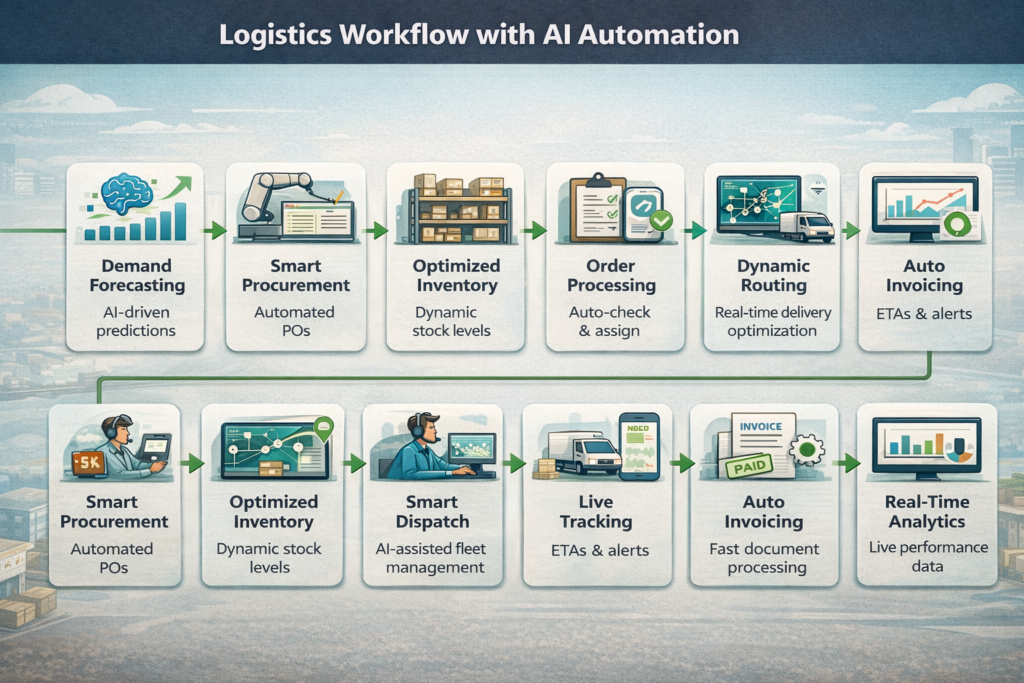
For years, logistics organizations focused on automation, warehouse systems, TMS platforms, barcode scanning, and ERP integrations. Supply chains are no longer stable enough for static rules and manual planning cycles. Demand changes weekly, routes are disrupted daily, and supplier reliability can shift overnight.
AI changes this dynamic by moving logistics operations from reactive execution to predictive and adaptive decision-making.
McKinsey & Company found that early adopters of AI in supply chain operations are already seeing meaningful gains, cutting logistics costs by about 15% and improving inventory outcomes by 35%.
Traditional systems show you where you are. AI tells you where congestion is building, what route will break next, and what alternative path keeps deliveries on time.
This matters now because:
- Customer tolerance for delays is shrinking
- Cost pressure is rising across fuel, labor, and compliance
- Sustainability reporting is becoming mandatory, not optional
- Global trade volatility is the new normal
AI allows logistics leaders to scale operations without scaling chaos, by improving visibility, foresight, and control across the entire network.
10 Key Areas for AI Automation in Logistics and Supply Chain
Below are the ten areas where AI delivers the most immediate and scalable impact today. Each section follows the same structure to keep the value practical and actionable.
1. Demand Forecasting
Most logistics organizations still rely on historical sales data and fixed planning cycles to forecast demand. This approach breaks down when demand shifts suddenly due to seasonality, promotions, weather events, or global disruptions. The result is a familiar pattern: excess inventory in some locations and stockouts in others.
AI-driven demand forecasting uses machine learning models to analyze far more signals than humans or spreadsheets ever could. Instead of looking backward only, AI continuously adjusts forecasts using real-time data like order velocity, regional demand patterns, external events, and even weather forecasts.
Companies like Amazon and Walmart rely heavily on AI forecasting to reposition inventory closer to demand before customers even place orders.
How to Implement AI Automation in Demand Forecasting
- ML models trained on multi-year demand data: Combine historical orders, seasonal trends, and regional demand patterns to generate more accurate forecasts.
- Integration with external data sources: Pull in weather data, promotional calendars, economic indicators, and market signals that influence buying behavior.
- Continuous forecast recalibration: Update forecasts daily or hourly instead of monthly, allowing plans to adapt in near real time.
- Demand sensing at SKU and location level: Move beyond aggregate forecasts to granular predictions by product, warehouse, and delivery zone.
- ERP and planning system integration: Feed AI forecasts directly into procurement, production, and replenishment workflows.
5 Benefits of AI in Demand Forecasting
- Reduces inventory holding costs by 10–30%
- Minimizes stockouts and emergency replenishment
- Improves warehouse space utilization
- Enables better transportation and labor planning
- Creates more predictable service levels for customers
2. Route Optimization & Last-Mile Delivery
Transport costs are among the highest line items in logistics, yet most delivery routes are still optimized using static rules or pre-set territories. This leads to inefficient fuel use, delayed deliveries, underutilized vehicles, and driver frustration, especially in last-mile operations where conditions change hourly.
AI-powered route optimization models analyze live variables such as weather, traffic, delivery density, vehicle load, and historical delays to find the most efficient delivery paths in real time. Unlike fixed-route systems, AI adapts minute by minute.
FedEx, UPS, and Amazon all use AI to dynamically optimize last-mile delivery, reduce emissions, and improve delivery success rates.
How to Implement AI in Route Optimization & Last-Mile Delivery
- Real-time data ingestion from GPS and telematics: Feed vehicle speed, route deviations, and stop durations into AI models.
- Dynamic rerouting algorithms: Adjust routes on the fly based on delays, cancellations, or drop priority.
- AI-powered cluster routing: Group stops for maximum delivery density while reducing fuel usage.
- Traffic and weather prediction models: Preemptively avoid bottlenecks or unsafe conditions.
- Customer ETA prediction using ML: Show accurate time windows based on route history, not guesses.
5 Benefits of AI in Route Optimization & Delivery
- Reduces fuel costs by 30%
- Improves on-time delivery by 15% or more
- Enhances customer satisfaction with accurate ETAs
- Lowers CO₂ emissions and supports ESG goals
- Optimizes fleet utilization and reduces driver overtime
3. Warehouse Automation
Manual warehouse operations struggle to keep pace with e-commerce scale and complexity. Picking errors, slow put-away times, and inefficient storage layouts lead to delays and extra costs. Without automation, even modern WMS platforms become bottlenecks.
AI enhances warehouse operations by controlling smart robots, optimizing layout design, and dynamically prioritizing pick-pack tasks. Vision systems and machine learning algorithms allow real-time slotting decisions and workforce orchestration.
Companies like Ocado, Element Logic, and Amazon use AI-controlled mobile robots and AI vision to boost throughput and reduce picking time per order.
How to Automate Warehouse Operations Using AI
- AI-powered robotic picking systems: Automate item picking using trained vision models for accuracy and speed.
- Computer vision for barcode and pallet scanning: Replace handheld scanners with cameras to verify shipments instantly.
- Dynamic slotting algorithms: Continuously optimize item placement based on pick frequency and order patterns.
- Workforce task orchestration via AI: Assign workers dynamically based on real-time task queue and skill level.
- Predictive workload balancing: Use AI to forecast labor demand and shift allocation based on orders.
5 Benefits of AI in Warehouse Management
- Increases pick speed by 2-3x
- Reduces picking errors by up to 90%
- Improves warehouse space usage by 20-25%
- Enhances safety by reducing manual handling
- Cuts training time for new workers
4. Predictive Maintenance
Logistics fleets and material handling systems suffer from unexpected breakdowns. Traditional preventive maintenance schedules are based on time or mileage, not actual equipment health, leading to either over-maintenance or costly failures.
AI-powered predictive maintenance monitors machine health in real time using IoT sensors and maintenance records. Machine learning models analyze patterns to predict when a part is likely to fail, so teams can intervene before downtime occurs.
How to Use AI for Predictive Maintenance in Logistics
- IoT sensors to monitor vibration, temperature, and usage: Feed real-time data from forklifts, trucks, conveyors, etc.
- Anomaly detection algorithms: Spot subtle changes in equipment behavior before they lead to failure.
- Predictive health scoring: Assign risk scores to machines based on historical patterns and sensor signals.
- Integration with maintenance scheduling tools: Automatically trigger service tickets or part orders.
- Mobile alerts to maintenance crews: Notify when action is required based on AI model thresholds.
5 Benefits of Predictive Maintenance with AI
- Reduces unplanned downtime by 30-50%
- Extends equipment lifespan through timely intervention
- Lowers repair costs by addressing issues early
- Minimizes delivery disruptions from fleet breakdowns
- Improves safety by catching issues before failure
5. Intelligent Supply Chain Planning
Supply chain planning often happens in disconnected silos with demand planners, procurement managers, and logistics coordinators working off spreadsheets or outdated ERP data. This fragmented view delays responses to supply disruptions or demand spikes and leads to suboptimal decisions.
AI-powered supply chain planning systems break down silos by analyzing signals across procurement, inventory, production, and logistics to optimize plans holistically. Machine learning models simulate scenarios like supplier delays or port congestion and recommend adaptive plans in real time.
How to Apply AI for Intelligent Supply Chain Planning
- End-to-end digital twin simulation: Create a virtual supply chain model to run “what-if” scenarios for demand surges, raw material delays, or transport bottlenecks.
- AI-driven inventory balancing: Automatically shift inventory across nodes based on predicted stockouts or surplus.
- Supplier reliability scoring: Predict delays or quality issues based on past performance and external risk indicators.
- Production scheduling optimization: Use AI to sequence jobs based on machine availability and downstream transport schedules.
- Integrated planning dashboards: Visualize AI recommendations for cross-functional alignment.
5 Benefits of AI in Supply Chain Decision-Making
- Improves service levels and order fill rates
- Reduces excess inventory and waste
- Enhances collaboration across procurement, ops, and logistics
- Enables faster, data-driven responses to disruption
- Increases forecast accuracy across multiple tiers
6. Fraud & Theft Detection
Cargo theft, inventory shrinkage, invoice fraud, and delivery scams cost the logistics industry billions annually. Yet, most fraud detection relies on manual audits or basic rule checks, leaving organizations vulnerable to hidden losses.
AI algorithms excel at detecting outliers and patterns in large datasets. By analyzing shipment data, sensor logs, financial records, and behavior histories, AI can flag inconsistencies, detect unauthorized access, or spot fraudulent activity in real time.
How to Detect Fraud and Theft in Logistics with AI
- Anomaly detection on freight bills: Identify mismatched amounts, fake vendors, or repeated invoice patterns.
- Computer vision for restricted zone access: Use cameras and AI to detect unauthorized personnel or unexpected behavior in warehouse areas.
- Geofencing + AI alerts: Trigger flags if trucks divert from approved routes.
- Transaction pattern analysis: Spot suspicious refund loops, duplicate invoices, or delivery manipulations.
- Cargo condition monitoring AI: Detect if seals are broken or containers opened in transit.
5 Benefits of AI in Logistics Security
- Reduces financial losses from shrinkage and fraud
- Enhances security compliance for sensitive goods
- Speeds up audit and investigation processes
- Protects brand reputation through tighter controls
- Enables proactive loss prevention
7. AI Chatbots for Logistics Coordination
Customer service teams and dispatchers are flooded with repetitive queries, “Where is my order?”, “What’s the ETA?”, “Can I reschedule my delivery?” Handling these manually slows response times and frustrates customers and internal teams alike.
AI chatbots can handle a significant portion of logistics-related interactions. They can access real-time shipment status, process change requests, and escalate only the complex cases to human agents.
How to Deploy AI Chatbots in Logistics Operations
- Shipment tracking chatbot: Pulls live status from TMS and shares it with customers 24/7.
- Driver support bot: Assists with route updates, delivery instructions, or delay reporting via voice or mobile.
- Warehouse internal helpdesk bot: Guides staff through safety protocols, inventory lookups, or reporting issues.
- Integrated AI voice agents: Handle IVR calls to automate appointment rescheduling or delivery updates.
- AI escalation logic: Flags sensitive or complex issues for human follow-up.
5 Benefits of AI Chatbots in Supply Chain Coordination
- Reduces human support workload by 60%
- Improves customer response time and satisfaction
- Operates 24/7 without additional headcount
- Ensures consistency in replies and protocol adherence
- Frees human teams to handle higher-impact issues
8. AI-Powered Pricing & Procurement
Procurement teams often rely on spreadsheets or past contracts to select carriers and suppliers, without considering dynamic variables like fuel costs, lead times, or performance history. This results in missed savings or risky partnerships.
AI enables smarter freight procurement, supplier selection, and dynamic pricing. It continuously evaluates market conditions, cost inputs, and supplier behavior to recommend optimal decisions.
How to Implement AI in Logistics Pricing & Procurement
- Supplier risk scoring models: Evaluate historical delivery, quality, compliance, and even ESG metrics.
- Dynamic freight pricing engine: Suggest pricing based on demand elasticity, distance, and historical win rates.
- RFQ document generation via Gen AI: Auto-draft detailed requests for quotes based on recent orders.
- Automated contract analysis: Extract pricing, payment terms, and clauses from logistics contracts using NLP.
- AI-led spot bidding platform: Match freight to carrier capacity in real time.
5 Benefits of AI in Procurement Optimization
- Reduces freight and procurement costs
- Avoids unreliable or high-risk vendors
- Speeds up procurement cycle time
- Improves negotiation leverage with data
- Supports compliance with sourcing policies
9. Document Processing (RPA + NLP)
Shipping documents, customs forms, invoices, and bills of lading are still processed manually in many logistics companies. This slows down shipments, introduces human errors, and clogs back-office teams during peak periods.
AI-powered document processing uses optical character recognition (OCR), natural language processing (NLP), and robotic process automation (RPA) to extract, validate, and process data from physical or digital documents instantly.
How to Automate Document Processing with AI
- OCR to read BOLs, invoices, and customs forms: Digitize scanned documents into structured data fields.
- Entity recognition with NLP: Extract shipper name, product codes, invoice totals, HS codes, etc.
- AI-powered exception handling: Flag documents with missing fields or mismatched values for review.
- Automated data entry into TMS/ERP: Push extracted info into back-end systems to trigger workflows.
- Email + attachment parsing bot: Reads PDF attachments and processes them as shipments or invoices.
5 Benefits of AI in Logistics Documentation
- Reduces document turnaround time by 70–80%
- Cuts manual data entry effort and error rates
- Speeds up customs clearance and billing
- Improves compliance through accurate audit trails
- Scales smoothly during peak volumes
10. Sustainability Optimization
Sustainability is no longer a marketing buzzword, regulatory pressure and customer expectations are pushing logistics providers to reduce emissions and improve transparency. But most companies struggle to measure, track, or optimize their carbon footprint in real time.
AI can analyze emissions data, optimize fuel usage, and suggest greener routing or packaging choices. It also helps companies generate auditable sustainability reports automatically.
How to Use AI for Sustainable Logistics Optimization
- Carbon-aware route planning: Choose paths that reduce emissions even if slightly longer in distance.
- Fuel usage prediction models: Identify high-consumption routes or driver behaviors and recommend change.
- AI-powered packaging optimization: Suggest size/material combinations that reduce waste and costs.
- ESG reporting automation: Consolidate emissions, packaging, and energy data for compliance reports.
- Supplier ESG scoring: Select vendors based on sustainability performance and carbon intensity.
4 Benefits of AI in Green Logistics
- Reduces total logistics emissions by 10-25%
- Improves compliance with carbon regulations
- Attracts ESG-conscious customers and partners
- Supports brand positioning in sustainability
5 AI Implementation Models for Logistics and Supply Chain
Choosing the right AI implementation model is critical for scale, performance, and long-term success. Below are five practical models logistics businesses can adopt based on system maturity, partner ecosystem, and data readiness.
- Embedded AI in TMS/WMS/ERP Platforms
These are prebuilt AI features inside TMS, WMS, or ERP systems like Oracle SCM or SAP. Best for mid-to-large logistics companies that want fast deployment without custom development. - API-Based AI-as-a-Service
Cloud-based AI tools offer OCR, chatbots, pricing models, and tracking insights via simple APIs. Ideal for startups and growing firms needing plug-and-play automation without building in-house. - Custom AI Models with Real-Time Data Feeds
This custom machine learning model is built on your own logistics, fleet, and inventory data. Suited for enterprises with large operations and the resources to fine-tune for accuracy. - AI-Powered Digital Twin + Simulation
A live digital model of your supply chain where AI can test “what-if” scenarios in real time. Perfect for global logistics networks needing proactive planning and disruption response. - Federated & Multi-Tier AI Across Partners
AI models that work across partners (vendors, 3PLs) without exposing raw data. Ideal for distributed supply chains where privacy and shared intelligence are critical.
7 AI Adoption Challenges in Logistics and Supply Chain
- Cost of sensors or real-time data infrastructure: Upgrading fleets and warehouses with IoT sensors, edge devices, or live GPS feeds is expensive, often blocking AI projects before they start.
- Risk of AI model hallucinations: Without clear constraints, AI can generate misleading predictions or responses, especially in GenAI applications like documentation or customer communications.
- Integration complexity with TMS/WMS/ERP: Legacy logistics systems often lack modern APIs or clean data pipelines, making AI integration slow, costly, and prone to failure.
- Resistance to change from ops teams: Many frontline staff distrust AI outputs or see automation as a threat, stalling adoption unless change management is built in.
- Supplier/vendor data access issues: AI needs visibility across partners, but many vendors don’t share timely or standardized data, limiting the value of demand forecasts or ETA models.
- Real-time vs batch data processing gaps: Most logistics systems update hourly or daily, but AI thrives on live data, creating latency that weakens decision-making.
- Compliance with ESG, customs, and cross-border AI rules: As AI touches regulated processes like emissions tracking or customs docs, firms face growing legal and audit risks, especially across countries.
Conclusion
AI has moved beyond the proof-of-concept stage, it’s now a core driver of operational efficiency and resilience across the logistics industry. Global leaders aren’t just experimenting; they’re embedding AI into everyday decisions, from shipment planning and route optimization to inventory control and real-time coordination.
What sets high-performing supply chains apart isn’t the use of AI alone, but how intelligently it’s integrated and aligned with business logic, data flows, and frontline workflows.
At Samarpan Infotech, we specialize in AI integration for supply chain and logistics operations. From automating repetitive workflows and improving demand visibility to building end‑to‑end intelligent control towers, we help organizations evolve from disconnected systems to predictive, adaptive logistics networks.
With over 10 years of experience in Tech industry at Samarpan Infotech with architect system, problem solving and creativity. "Today is the only day. Yesterday is gone".