How AI Automation Is Reshaping the Retail Ecommerce Industry

Retail eCommerce has always been about timing, precision, and experience. But in today’s environment, shaped by rising costs, shifting demand, and omnichannel complexity, traditional methods are falling short.
Shoppers want seamless, personalized, and instant experiences. Behind the scenes, this requires thousands of micro-decisions, which products to restock, which prices to adjust, which customers to retarget, which messages to send, and how to fulfill each order, all in real time. Manual processes can’t keep up.
AI automation introduces a new model: decision-making at machine speed, powered by data and algorithms, and executed automatically. For retailers, this means scaling efficiently without scaling costs. For customers, it means better service without waiting.
10 Retail Ecommerce Functions Being Transformed by AI Automation
1. Inventory Forecasting & Replenishment
Retailers often rely on gut instinct, static spreadsheets, or outdated ERP data to forecast demand. This leads to overstocking low-moving items and understocking bestsellers, both of which cut into margins and customer satisfaction. In fast-moving categories like fashion or electronics, even minor inaccuracies can trigger major losses.
AI-powered forecasting uses historical sales, real-time demand signals, seasonality trends, and even social media sentiment to generate predictive restock models. H&M, for instance, uses machine learning to analyze store-level purchase data and optimize inventory allocation across regions.
How AI Automation Can Be Implemented
- Identify Demand Volatility Zones: Flag SKUs with irregular sales patterns or high return rates.
- Train Forecast Models with Time-Series Data: Use tools like Prophet (ML library for time series forecasting) or AWS Forecast with sales history, weather, and promotions as inputs.
- Connect POS and Warehouse Systems via API: Feed real-time sales into the model and trigger restock alerts automatically.
- Set Smart Reorder Thresholds: Automate purchase orders when predicted stock falls below optimal levels.
- Allow Managerial Review with Adjustment Levers: Let human planners tweak forecasts before finalizing orders.
5 Benefits of AI Automation
- Improves forecast accuracy by up to 50% (McKinsey)
- Reduces excess inventory holding by 20-30%
- Minimizes out-of-stock events by 35%
- Frees up planning teams from manual spreadsheet work
- Increases customer satisfaction through better product availability
2. Dynamic Pricing and Margin Optimization
Manual pricing updates, based on competitor checks or end-of-season markdowns, miss opportunities to optimize revenue in real time. They’re slow, reactive, and disconnected from actual customer behavior or demand elasticity.
AI-powered pricing tools analyze supply, demand, competitor moves, customer segments, and purchase patterns to optimize prices automatically. Zara, for example, uses dynamic pricing models to adjust markdowns across geographies to clear seasonal inventory without sacrificing margin.
How AI Automation Can Be Implemented
- Gather Real-Time Market Signals: Track competitor pricing, stock status, and promotional campaigns.
- Use Demand Forecasting to Predict Price Sensitivity: Adjust prices based on volume elasticity models.
- Apply Rule-Based Dynamic Pricing Algorithms: Set constraints like minimum margin or category limits.
- A/B Test Prices on Low-Risk SKUs: Measure uplift and refine the model.
- Integrate Pricing Engine with Checkout & Ads: Sync live prices across web, app, ads, and POS.
5 Benefits of AI Automation
- Boosts profit margins up to 22% through optimized pricing.
- Increases sell-through rates with minimal markdowns
- Reduces human error in price updates
- Improves customer loyalty through fair and personalized pricing
- Enables flash pricing during high-demand spikes
3. Customer Service and Support Automation
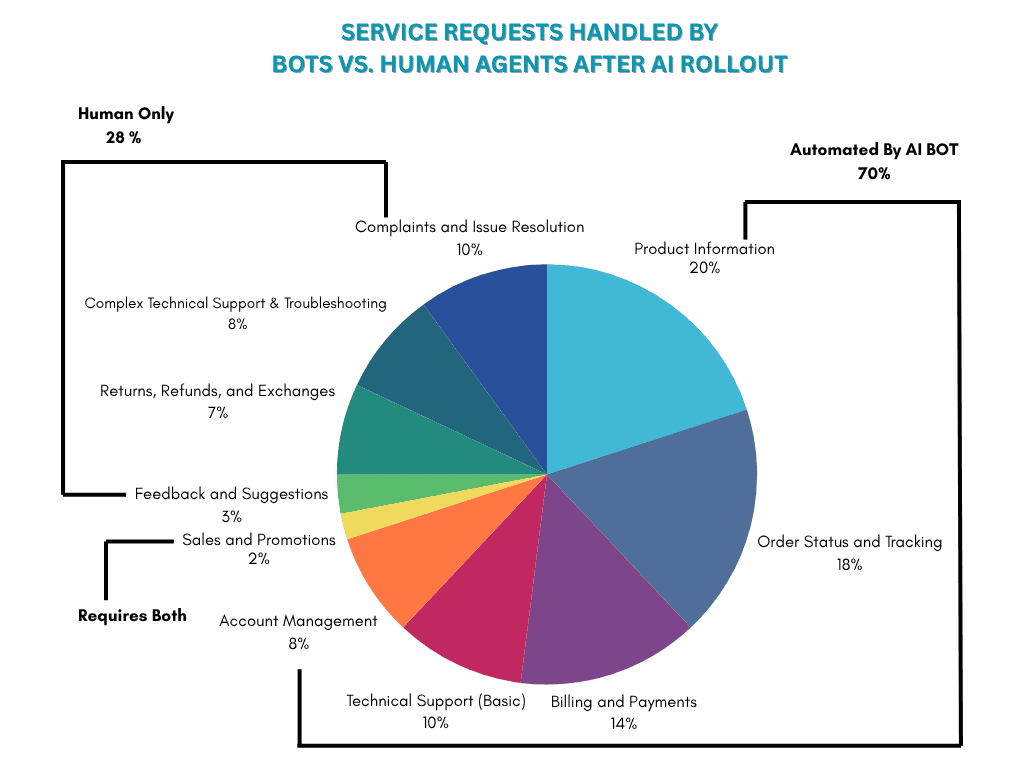
Retail customer service teams are overwhelmed with repetitive queries like order tracking, return status, and product questions, leading to long wait times and inconsistent answers. Scaling human support 24/7 is expensive and hard to maintain.
AI chatbots and voice agents trained on your product, order, and policy data can handle 80%+ of queries without human escalation. Many businesses already use conversational AI for appointment booking, order queries, and product help, freeing human agents for complex issues.
How AI Automation Can Be Implemented
- Train AI Bots on FAQs and Order Systems: Use tools like Intercom, Ada, or Dialpad AI to build NLP-powered bots.
- Integrate CRM & Order Systems with Bot Backend: Let bots fetch real-time order or return status.
- Deploy Voice AI for Phone-Based Support: Use LLMs + voice APIs to handle calls.
- Use Sentiment Analysis to Escalate Edge Cases: Route complex issues to human agents in real time.
- Log and Analyze Conversations for Insights: Use transcripts to improve service workflows or identify CX issues.
5 Benefits of AI Automation
- Reduces response time by 70%
- Cuts customer service costs by up to 30%
- Improves CSAT scores with 24/7 instant support
- Enables multilingual service without extra hiring
- Frees human agents to focus on high-value problems
4. Visual Merchandising & Product Discovery
Most eCommerce stores still rely on static product listings, generic filters, and manually curated category pages to guide shoppers. But with expanding catalogs and diverse customer preferences, surfacing the right products at the right time becomes difficult. The result? Shoppers struggle to discover relevant items, leading to lower engagement and drop-offs.
AI-powered visual merchandising automatically adapts product displays based on shopper behavior, context, and intent. It combines computer vision, real-time interaction tracking, and historical purchase data to arrange storefronts dynamically.
According to McKinsey’s State of Fashion report, online shoppers are overwhelmed by choice, with 74% reporting they walk away from purchases due to too many options and 80% dissatisfied with online search relevance.
How AI Automation Can Be Implemented
- Tag Product Images with Computer Vision: Classify items by style, color, silhouette, and occasion to enrich metadata.
- Track Session-Level Behavior Signals: Monitor clicks, scroll depth, bounce rate, and time-on-page to learn about shopper preferences.
- Personalize Collections in Real-Time: Dynamically reorder product grids and carousels based on predicted interest.
- Build Adaptive Merchandising Rules: Prioritize in-stock, high-converting, or seasonally relevant products for each user segment.
- Test and Optimize Layouts Automatically: Use AI to experiment with category layouts (grid vs. list), number of rows, or banner placement to maximize conversions.
5 Benefits of AI Automation
- Improves product discovery rates by 40% through relevance-based sorting
- Reduces merchandising team effort by automating display logic
- Lifts average session duration and pages per visit
- Enhances mobile UX with optimized browsing flows
- Boosts conversions by showing the right products at the right time
5. Fraud Prevention and Transaction Monitoring
As online shopping scales, so does digital fraud. Retailers face growing threats from fake accounts, carding attacks, refund abuse, and account takeovers. Traditional rule-based fraud systems are reactive and often too rigid. They miss sophisticated fraud patterns while triggering false positives that block legitimate buyers and hurt revenue.
AI-powered fraud detection uses real-time behavioral analysis, anomaly detection, and predictive modeling to flag risky transactions more accurately. Machine learning models learn from historical fraud attempts and adapt to new attack vectors.
How AI Automation Can Be Implemented
- Analyze Historical Fraud Patterns: Train ML models using chargebacks, flagged transactions, and known fraud indicators.
- Monitor Behavioral Biometrics: Track keystrokes, session velocity, device fingerprints, and purchase behavior to detect abnormal activity.
- Score Transactions in Real-Time: Assign dynamic risk scores to each action during checkout or login, and set thresholds for blocking or manual review.
- Automate Escalation Workflows: Trigger secondary verification steps or flag high-risk actions for manual analyst intervention.
- Continuously Improve Models with Feedback Loops: Feed fraud review outcomes back into the model to refine accuracy and reduce false positives.
5 Benefits of AI Automation
- Reduces chargeback rates and fraud-related losses
- Improves approval rates by minimizing false declines
- Protects user accounts without adding login friction
- Scales fraud monitoring without hiring large analyst teams
- Adapts to evolving fraud techniques without rewriting rules
6. Returns, Logistics & Reverse Fulfillment
Returns are an unavoidable part of eCommerce, but they’re also one of the costliest. Manual return processing leads to delays in refunds, poor customer experience, and rising logistics expenses.
Moreover, without proper classification, many returned items are either discarded or restocked inefficiently, resulting in revenue leakage and operational waste. High return rates from serial returners or fraudulent claims adds further complexity.
AI automates and optimizes the entire returns lifecycle, from approval to classification to restocking or liquidation. It uses machine learning to predict return intent, identify abuse patterns, and determine the best disposition path (restock, refurbish, resell, or recycle).
How AI Automation Can Be Implemented
- Predict Return Likelihood at Checkout: Use historical behavior and product attributes to flag high-risk orders in advance.
- Classify Return Reasons with NLP: Analyze free-text inputs to categorize returns and identify quality or sizing issues.
- Automate Refund Approvals and Logistics: Trigger instant refund workflows and auto-generate return labels for valid cases.
- Route Returns Intelligently: Decide whether to restock, inspect, refurbish, or redirect returned items based on condition predictions.
- Detect and Block Return Abuse: Identify serial returners or fraudulent refund requests using behavior analysis.
5 Benefits of AI Automation
- Cuts return processing time by 40–60%, improving CX and team efficiency
- Reduces logistics costs by automating routing and restocking decisions
- Minimizes revenue loss from fraudulent or abusive returns
- Improves inventory accuracy by auto-classifying returned goods
- Provides insights into product issues that drive return volume
7. Automated Product Content Creation
For retailers managing hundreds or thousands of SKUs, creating consistent, high-quality product titles, descriptions, meta tags, and alt texts is a constant bottleneck. Manual content generation takes time, is prone to inconsistencies, and often delays product launches, especially in multi-language or multi-market environments.
Generative AI tools can automatically create, edit, and optimize product content based on key attributes, brand tone, and search intent. These systems use natural language generation (NLG) and computer vision to produce rich, scalable content at speed.
Amazon, for instance, now uses AI to generate bullet points and titles for new listings, saving time while improving search visibility and consistency.
How AI Automation Can Be Implemented
- Extract Product Attributes from Data Feeds: Use AI to pull size, material, color, dimensions, and specs from inventory systems or supplier sheets.
- Generate Descriptions with Language Models: Use LLMs (like GPT-based tools) to create SEO-optimized titles, short/long descriptions, and usage guides.
- Translate and Localize Content at Scale: Deploy machine translation tools fine-tuned with brand vocabulary for region-specific language and compliance.
- Auto-Generate Alt Texts for Accessibility: Use computer vision to describe product images, enhancing UX.
- Personalize Messaging by Channel: Customize product copy for email, ads, website, or marketplaces using behavioral segmentation and copy variations.
5 Benefits of AI Automation
- Accelerates time-to-market for new product listings
- Ensures brand consistency and tone across large catalogs
- Boosts SEO with structured, keyword-optimized descriptions
- Improves accessibility and compliance with alt text automation
- Saves up to 80% of manual content creation effort.
8. Hyper-Personalization at Scale
Traditional segmentation methods, such as demographics or purchase history, can only deliver basic personalization. They fail to adapt in real time or consider deeper behavioral patterns. As a result, many customers receive irrelevant product recommendations, generic emails, or poorly timed promotions.
AI enables real-time, one-to-one personalization across channels by analyzing browsing behavior, purchase intent, contextual signals, and even sentiment. It builds dynamic customer profiles (often called “customer genomes”) that continuously evolve.
Retailers like Stitch Fix and Amazon use AI-powered personalization to recommend products, time offers, and adjust messaging with precision, often leading to uplift in revenue per user.
How AI Automation Can Be Implemented
- Build Real-Time Behavior Profiles: Track clickstreams, time on page, cart activity, and search behavior to model intent.
- Predict Product Affinity with ML Models: Use collaborative filtering or neural networks to identify what products users prefer.
- Segment Customers Dynamically: Replace static lists with real-time clusters based on lifecycle stage, AOV (Average Order Value), and churn risk.
- Personalize Content Across Channels: Tailor emails, homepage banners, product carousels, and notifications to each user in real time.
- Trigger Automated Offers Based on Micro-Moments: Send discount codes, cart nudges, or loyalty points based on intent signals.
5 Benefits of AI Automation
- Increases average order value through tailored suggestions
- Improves click-through rates on campaigns with hyper-targeted messaging
- Reduces churn by identifying disengaged users and triggering re-engagement
- Boosts customer lifetime value (CLV) with relevant, timely experiences
- Enhances brand loyalty through consistently personalized interactions
9. AI-Driven Loyalty and Engagement Engines
Most loyalty programs rely on static point systems, generic email blasts, or post-purchase rewards that don’t adapt to customer behavior or intent. As a result, many programs see low engagement, poor redemption rates, and limited impact on customer retention.
AI turns loyalty programs into intelligent engagement engines by analyzing purchase patterns, frequency, sentiment, and lifecycle stage to trigger relevant offers at the right time. It dynamically scores customer value and predicts churn risk, enabling retailers to reward proactively and retain strategically.
How AI Automation Can Be Implemented
- Score Customer Value with Predictive Models: Use RFM (recency, frequency, monetary) or ML-based CLV scoring to prioritize segments.
- Trigger Loyalty Rewards in Real Time: Offer dynamic points, discounts, or experiences based on behavior, such as a third purchase or high-ticket item.
- Personalize Loyalty Messaging: Adapt messaging tone, visuals, and timing based on past response patterns and engagement levels.
- Automate Churn Prevention Tactics: Identify at-risk customers and send re-engagement rewards or reminders via their preferred channel.
- Connect Loyalty with Product and Content Engines: Use loyalty status to influence recommendations, access levels, or early product drops.
5 Benefits of AI Automation
- Increases loyalty engagement by delivering relevant rewards, not generic perks
- Companies using targeted promotions typically see a 1-2% sales lift.
- Boosts redemption and click-through rates through timely offers
- Reduces churn by predicting and preempting drop-off behavior
- Enables scalable, data-driven loyalty programs with minimal manual input
10. Operations and Fulfillment Automation
As order volumes grow and customer expectations tighten, traditional fulfillment systems face serious strain. Manual warehouse coordination, static picking routes, delayed handoffs between systems, and disconnected shipping processes all contribute to higher costs and slower delivery. These inefficiencies are especially painful during flash sales, holiday peaks, or subscription cycles, where speed and accuracy are non-negotiable.
AI brings intelligence and automation to core fulfillment workflows, warehouse operations, carrier selection, route optimization, and post-purchase tracking. It analyzes real-time order flow, inventory position, and carrier data to make decisions that would overwhelm human teams.
How AI Automation Can Be Implemented
- Optimize Warehouse Picking Paths with AI: Use ML to generate dynamic picking sequences based on order clustering and location mapping.
- Automate Order Batching and Slotting: Group orders for efficient packing and dispatch based on carrier cutoff times and delivery zones.
- Predict Optimal Carrier and Delivery Time: Use AI to match orders with carriers based on delivery speed, reliability, and cost.
- Monitor Inventory Movement in Real Time: Track SKU flow across fulfillment centers to rebalance automatically when demand spikes.
- Automate Post-Purchase Updates and Returns: Trigger real-time notifications, tracking links, and return instructions through integrated systems.
5 Benefits of AI Automation
- Speeds up fulfillment cycles, especially during high volume
- Reduces labor costs by minimizing manual picking and routing
- Improves delivery accuracy and customer satisfaction
- Lowers shipping costs by optimizing carrier selection in real time
- Provides transparency across the fulfillment lifecycle, reducing WISMO calls (“Where Is My Order”)
5 Key Challenges Retailers Must Address Before AI Automation
1. Fragmented and Dirty Data:
AI models are only as good as the data feeding them. Many retailers still operate with siloed systems, POS, CRM, warehouse, and web analytics are not in sync. Incomplete or inconsistent product attributes, customer profiles, or order history degrade the quality of predictions and automation triggers.
2. Over-Reliance on “Plug-and-Play” Tools
Generic AI apps or no-code platforms may seem attractive at first but can lead to superficial automation that doesn’t scale. Customization, ongoing training, and domain-specific logic are often required for meaningful results, especially for mid-to-large catalogs or omnichannel operations.
3. Lack of Internal AI Readiness
AI automation is not just a tech upgrade, it requires new workflows, new skills, and cultural shifts. Teams often lack training on how to use, govern, and improve AI systems. Without cross-team collaboration (merchandising, IT, operations, CX), automation initiatives may underdeliver.
4. Managing Exceptions and Edge Cases
Automation works well for the 80%, but what about the 20% of edge cases, unusual orders, VIP complaints, hybrid returns? Without thoughtful human-in-the-loop oversight, these exceptions can create friction, harm CX, or escalate risk.
5. Ethical and Brand Risk
AI that generates content or makes decisions about pricing, personalization, or messaging must be monitored carefully. Bias, hallucination, or overly aggressive targeting can damage brand trust. Retailers must ensure explainability, compliance, and alignment with brand voice across all automated touchpoints.
AI Automation Implementation Roadmap for E-Commerce
Phase 1: AI Readiness & Planning
- Audit workflows: Identify repetitive, high-impact tasks across inventory, pricing, support, and content.
- Clean/unify data: Consolidate inventory, sales, and customer data into one structured system.
- Pick quick wins: Start with low risk use cases like automated product descriptions or chatbots.
- Set KPIs: Define clear goals for cost savings, speed, accuracy, and customer experience.
- Form AI task force: Align IT, ops, CX, and business teams on a shared automation strategy.
Phase 2: Pilot AI Use Cases
- Launch pilots: Test AI tools for forecasting, fraud detection, or loyalty triggers in isolated environments.
- Use lightweight tools: Leverage APIs or SaaS platforms to avoid heavy engineering upfront.
- Connect to live data: Integrate pilots with your existing POS, ERP, or CMS systems.
- Collect feedback: Track results from users, customers, and stakeholders to guide refinement.
- Review results: Use metrics to decide which pilots to expand or redesign.
Phase 3: Operationalize Successful Use Cases
- Standardize workflows: Automate repetitive processes across core operations (pricing, returns, etc.).
- Trigger automation: Set rules and thresholds that automatically initiate AI actions.
- Include human oversight: Route edge cases or sensitive tasks to human teams for review.
- Train your teams: Educate users on how to interact with and adjust AI-powered systems.
- Ensure data flow: Set up real-time data refresh and compliance checks for automated decisions.
Phase 4: Scale Across Functions & Channels
- Expand automation: Introduce AI to marketing, finance, logistics, and merchandising teams.
- Unify channels: Apply consistent AI logic across site, app, stores, email, and marketplaces.
- Enhance personalization: Use AI to deliver customer-specific messaging and product suggestions.
- Automate insights: Summarize AI recommendations in dashboards for faster decision-making.
- Monitor models: Regularly check for AI drift and retrain models to maintain performance.
Phase 5: Optimize, Customize, and Innovate
- Build custom models: Tailor AI to your brand voice, product mix, and customer behavior.
- Optimize in real time: Use AI feedback loops to dynamically adjust pricing, fulfillment, and messaging.
- Go composable: Create modular AI blocks that plug into various tools and systems.
- Explore edge AI: Test real-time AI applications in kiosks, stores, or IoT environments.
- Innovate continuously: Use customer and ops data to fuel an ongoing AI improvement cycle.
Conclusion
Retailers today aren’t just selling products, they’re providing real-time experiences across systems, screens, and storefronts. Which is becoming too complex to manage manually. AI automation steps in not to replace human insight, but to amplify it, removing the friction, guesswork, and delays that slow down modern commerce.
At Samarpan Infotech, we help retail eCommerce businesses implement AI integration solutions that are not just smart, but sustainable, designed to evolve with your business, your customers, and your data. The future of eCommerce isn’t just digital, it’s automated, adaptive, and AI-driven.
With over 10 years of experience in Tech industry at Samarpan Infotech with architect system, problem solving and creativity. "Today is the only day. Yesterday is gone".