Frontend vs Backend Development: Discover Key Differences

Web development is like building a house. In this world, Frontend and Backend development are two main parts that help build a complete website or app, much like how different teams work together to build a house. If you are new to web development or own a business, knowing about these parts can be very helpful.
Now, there’s also something called Full Stack Development. This is like being a handyman who knows a bit of everything – both the Frontend and Backend. Full Stack developers can work on what you see (Frontend) and what you don’t see (Backend) on a website or app. This easy guide will help you understand the main differences between Frontend and Backend development. We’ll talk about languages, tools, and roles in each area.
What is Frontend?
Frontend, synonymous with client-side development, is essentially the user interface and user experience of a website or application. It’s the realm where developers create an intuitive, attractive, and accessible interface for users to interact with. The aesthetics, layout, interactivity, and overall user experience are crafted and homed in this domain.
What is Front-End Development?
Front-end development is the practice of converting design mockups into fully functional, interactive, and accessible web interfaces. This involves not only a good understanding of design principles but also a strong command of front-end frameworks and languages. The goal is to provide a seamless, enjoyable user experience across various devices and browsers.
Front-end Development Languages
- JavaScript: The backbone of front-end development, JavaScript enables developers to create interactive and dynamic elements on a webpage. From simple animations to complex single-page applications, JavaScript powers the interactive elements that engage users.
- HTML: HTML is the foundational markup language used to create the structure of web pages. It’s like the skeleton that holds the content of the webpage in place, defining the structure of headings, paragraphs, links, and other elements.
- CSS: CSS is the stylesheet language used to style HTML elements. It controls the layout, appearance, and responsiveness of the webpage, ensuring a visually appealing design across various screen sizes.
Popular Frontend Frameworks
- React: Developed and maintained by Facebook, React is a library used for building user interfaces, particularly single-page applications where you need a fast, interactive user experience.
- Angular: A platform for building mobile and desktop web applications, Angular is a complete rewrite from the same team that built AngularJS. Angular provides a wide range of tools for web developers. Angular component library, which contains ready-made elements to help development faster and better, is one important tool.
- Vue.js: Vue is a progressive JavaScript framework used for building user interfaces. It’s designed from the ground up to be incrementally adaptable.
What does a Frontend developer do?
Frontend developers are responsible for implementing visual elements that users see and interact with in a web application. They usually collaborate with designers to translate design mockups into fully functional websites or applications. Their goal is to ensure that users have a seamless, enjoyable experience.
What skills are required for a Frontend developer?
- Proficiency in JavaScript, HTML, and CSS: Mastery over these three languages is crucial for creating interactive, well-structured, and styled web pages.
- Responsive Design: Understanding the principles of responsive design to ensure web pages look good on devices of all sizes.
- Familiarity with Frontend Frameworks: Knowledge of frameworks like React, Angular, or Vue.js can significantly speed up development and improve code quality.
- Version Control: Familiarity with version control systems like Git helps in tracking changes in code during software development.
What is Backend?
The backend, or server-side, is where the data is stored, manipulated, and sent to the front end to be displayed. It’s the powerhouse behind the scenes that makes a website or application function seamlessly.
What is Back-End Development?
Back-end development involves creating and maintaining the core logical structures that power the front-end. This includes databases, servers, and server-side applications that process and manage data.
Back-end Development Languages
- Python: Known for its simplicity and readability, Python is a versatile language used in various domains, including web development, data analysis, machine learning, artificial intelligence, scientific computing, etc.
- Java: A robust, platform-independent language, Java is used in a variety of server-side development projects. It writes once, run anywhere (WORA) capability makes it a favorite among many organizations.
- Ruby: Known for its simplicity and productivity, Ruby, along with its framework Ruby on Rails, is often the choice for startups and small to medium-sized enterprises.
- PHP: A widely used open-source scripting language, PHP is especially suited for web development and can be embedded into HTML.
- C++: Known for its performance efficiency, C++ is used in system/software, drivers, client-server applications, and high-performance servers.
Popular Backend Frameworks
- Django: A high-level Python framework, Django encourages rapid development and clean, pragmatic design.
- Ruby on Rails: Often referred to as Rails, it’s a web application framework written in Ruby, emphasizing convention over configuration and the don’t repeat yourself (DRY) principle.
- Node.js: Although not a framework but a runtime, Node.js allows the execution of JavaScript on the server-side, boasting an event-driven architecture capable of asynchronous I/O. As of 2023, Node.js is the first most popular web framework among software developers globally. According to the survey, around 42.65% of users use Node.js.
What does a Backend developer do?
Backend developers are responsible for the server-side logic, databases, and integration of server-side logic with the front-end. They create, code, and improve the server, server-side applications, and databases that, when combined with front-end codes, help create a functional, seamless application.
What skills are required for a Backend developer?
- Proficiency in Backend Languages: Mastery over at least one server-side language like Python, Ruby, PHP, Java, or C++ is crucial.
- Database Management: Understanding of database technologies like MySQL, Oracle, and SQL Server is essential to store, manipulate, and retrieve data.
- Server Management: Knowledge of handling server environments, deploying applications, and performance tuning is necessary.
- Version Control Systems: Like front-end developers, back-end developers also need to be familiar with version control systems to track changes and work collaboratively with other developers.
4 Key differences between Frontend vs Backend
In this section, we’ll explore the main differences between Frontend and Backend development. We’ll look at the different tools and languages they use, what roles Frontend and Backend developers play, and the unique skills needed for each area.
1. Comparison of languages and frameworks used
The languages and frameworks used in Frontend and Backend development are tailored to meet the unique demands of each domain. Frontend development primarily relies on the trio of HTML, CSS, and JavaScript, with frameworks like React, Angular, and Vue.js simplifying and accelerating the development process. On the other hand, Backend development employs a variety of languages such as Python, Java, Ruby, PHP, and C++, with frameworks like Django, Ruby on Rails, and Node.js facilitating robust server-side development.
2. Differences in roles and responsibilities
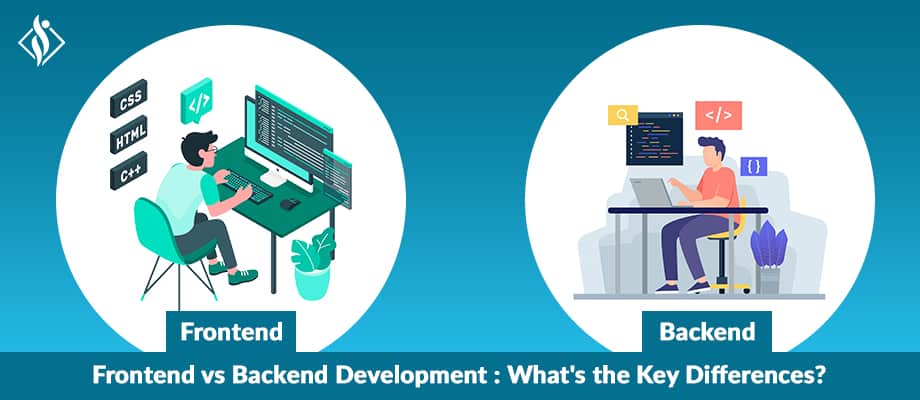
Frontend developers are akin to architects and interior designers of the digital realm, crafting visually appealing and intuitive user interfaces. Their focus is on user experience, aesthetics, and ensuring consistency across various devices and browsers.
Backend developers, on the other hand, act as the engineers who construct the foundation and the structure that holds and powers the application. They focus on server-side logic, databases, and ensuring seamless communication between the server and the front end.
3. Skill set comparison
Frontend developers need a blend of creative and technical skills. They should have a keen eye for design, understanding of user-centric design principles, and proficiency in front-end languages and frameworks.
Backend developers require a strong analytical mindset, problem-solving skills, and a deep understanding of server-side languages, databases, and server management. They should also be adept at creating efficient algorithms and data structures to solve complex problems.
4. Development environments and tools
Frontend and Backend developers use different sets of tools and environments tailored to their respective domains. Frontend developers use text editors like Visual Studio Code or Sublime Text, along with browser dev tools and frameworks’ own debugging tools. They also use version control systems like Git and task runners like Gulp or Webpack.
Backend developers often use integrated development environments (IDEs) like IntelliJ IDEA, PyCharm, or Eclipse. They also rely on database management systems, server environments, and containerization tools like Docker.
Which one should you choose?
Choosing between Frontend and Backend development largely depends on your interests and long-term career goals. If you have a penchant for design, enjoy crafting user interfaces, and have a keen eye for detail, Frontend development could be your calling. On the flip side, if you enjoy problem-solving, have a logical mindset, and are intrigued by data management and server-side logic, Backend development might be the right path for you.
Conclusion
Frontend and Backend development are two different areas of web development, but they work together to create a good website or app. Think of Frontend as the part you can see and touch, like the design and buttons on a website. On the other hand, Backend is like the engine behind the scenes that makes everything run smoothly.
It’s important to understand what each area does, especially if you’re thinking about becoming a developer or managing a web project. If you decide to learn Frontend development, you’ll work on the design and what users interact with. If you choose Backend, you’ll work on the behind-the-scenes stuff that makes the website or app work properly.
I am working as Jr. Full Stack Developer (.NET/Angular) at Samarpan Infotech. I've good analytical thinking and collaboration skills, and I love working with a team.