What to Consider Before Starting Any AI Integration Project


Artificial Intelligence (AI) is no longer an experimental initiative, it’s a strategic imperative. According to research, AI could contribute up to $15.7 trillion to the global economy by 2030, with productivity gains and personalized products leading the charge. And yet, for every success story, there are countless stalled pilots, misaligned implementations, and overengineered solutions that never reach ROI.
Why? Because AI integration is not just a technical deployment, it’s an organizational transformation. From defining use cases and validating data pipelines to ensuring ethical guardrails and team readiness, there’s a lot to consider before writing your first line of code.
Top 10 Things to Consider Before Starting AI Integration Project
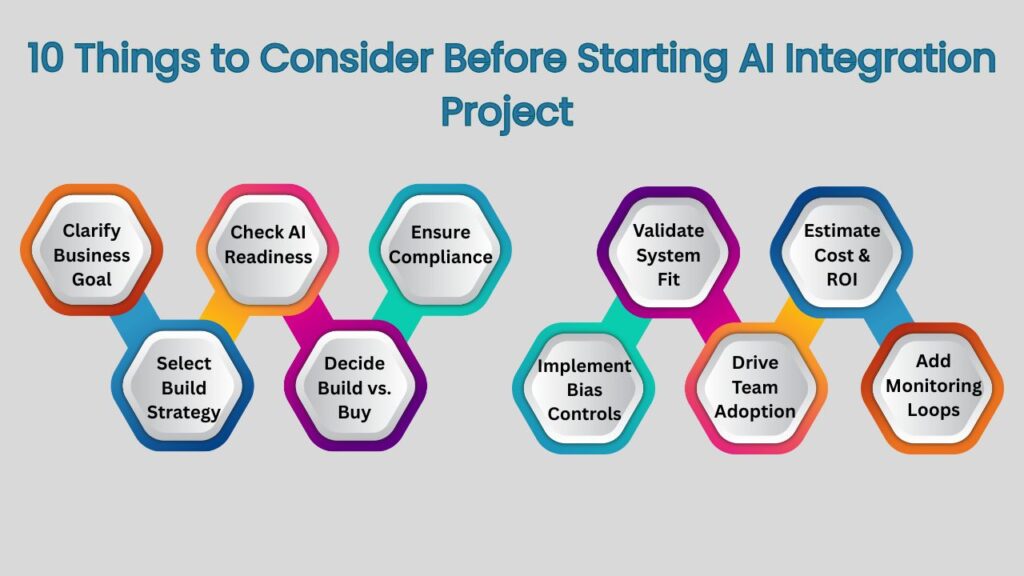
1. Define Your Business Objective
Many AI projects fail not due to technical reasons, but because they never had a clearly scoped purpose to begin with. Avoid building AI for the sake of innovation, start by pinpointing a measurable, high-impact problem.
What specific business problem are we solving, and why is it worth solving now?
Are we targeting a problem that directly affects our operational efficiency, customer satisfaction, or revenue leakage? For example, in insurance manual triaging of claims, in eCommerce, it could be the high rate of cart abandonment in legal or compliance-driven industries, it could be the need to extract key clauses from hundreds of contracts. What makes it urgent is the measurable impact on core KPIs.
Is AI the most appropriate tool, or could traditional automation be more effective?
AI is best suited when the problem involves high-volume, unstructured, or unpredictable data, like images, free-text documents, or behavioral signals. In contrast, if the process follows strict, linear business rules with minimal variation traditional rule-based automation or Robotic Process Automation (RPA) may be more cost-effective and easier to maintain.
If you’re uncertain whether AI is the right solution or how to scope the problem effectively, AI consulting can help validate use-case feasibility, align goals with KPIs, and avoid costly missteps.
How will we define success, and what metrics will validate impact?
For instance, we may aim to reduce customer support resolution times by 40% or increase predictive accuracy in lead scoring by 20%. These metrics will not only validate the effectiveness of the AI system but also inform when it’s ready to scale. Without well-defined KPIs, we risk investing in models that perform technically well but fail to move the needle on actual business performance.
2. Assess Internal AI Readiness
AI readiness isn’t just about having data, it’s about having the right data, tools, infrastructure, and skills to manage the AI lifecycle from training to retraining.
Do we have access to structured, labeled, and representative data?
AI systems are only as good as the data they learn from. This means having access to well-organized datasets that not only reflect the diversity of real-world scenarios but are also labeled correctly for training purposes. Assess your datasets for quality, consistency, coverage, and bias. If labeling is needed, factor that into your timeline and budget.
Can our infrastructure handle model training, deployment, and scaling?
AI workloads require compute-intensive resources. Infrastructure should be evaluated across three stages: experimentation (training and fine-tuning), deployment (integration with production systems), and scaling (multi-user or multi-region support).
For deep learning models or large transformer-based systems, you’ll need GPU or TPU clusters, distributed storage, scalable orchestration, and observability tools to monitor system health. Before starting, ensure your current infrastructure can meet both current needs and anticipated scale.
3. Address Legal, Compliance, and Ethical Concerns
As AI becomes more powerful, regulators are scrutinizing how it impacts fairness, privacy, and accountability. Compliance isn’t optional, it’s foundational.
What regulatory requirements apply to our use case, and how will we demonstrate compliance?
AI systems must comply with a complex mix of global regulations that vary by region and sector. GDPR (General Data Protection Regulation) in EU, CCPA (California Consumer Privacy Act), HIPAA (Health Insurance Portability and Accountability Act) in US each impose specific requirements around data use, transparency, and fairness. No matter the jurisdiction, AI must follow privacy-by-design principles, like data minimization and purpose limitation.
Who is liable if the AI system causes harm, bias, or legal exposure?
Clearly assign ownership for errors made by AI systems, whether internal, shared with a vendor, or governed by contractual SLAs (Service Level Agreement). Liability clarity prevents finger-pointing later.
Can we explain how our AI makes decisions, and are those decisions auditable?
You can use model explainability tools (e.g., SHAP, LIME) and maintain logs for every inference, input, and retraining session. Ethical AI requires visibility into its decision logic.
4. Choose the Right Build Strategy
There’s no one-size-fits-all approach to AI development. Your build strategy must reflect the complexity of the problem, your time-to-market goals, and your resourcing capacity.
Should we build our solution from scratch, fine-tune an existing model, or purchase off-the-shelf?
Building from scratch gives you complete control and domain alignment, but it’s resource-heavy and time-intensive, typically suited for tech-native firms or highly specialized needs.
Fine-tuning pre-trained foundation models like GPT or LLaMA offers a balanced approach: faster development with domain-specific adaptation.
Buying off-the-shelf AI tools is ideal for common use cases and quick deployment, though with limited flexibility. Ultimately, your decision should reflect your risk tolerance, required customization level, and urgency to deliver results.
How customizable and extensible is our chosen approach?
Whichever strategy you adopt, you must ensure the solution can evolve with your business needs. Ask whether the architecture supports swapping components, like switching model, integrating a new feature, or adapting to new data schemas.
Off-the-shelf tools often limit extensibility, while open-source or fine-tuned models allow more adaptability but require internal capability. To avoid vendor lock-in or technical debt, prioritize modularity, open standards, and API-first design from the start
What’s our fallback if the model doesn’t deliver expected value?
No AI project should proceed without a fallback strategy for when expectations aren’t met. The best approach is to pilot in a limited, low-risk environment with clear success metrics and rollback triggers. Design modular workflows where you can easily replace components or roll back to simpler logic if initial results underperform.
5. Build In-House or Work with a Vendor
This decision determines how quickly you go to market, how much control you retain, and how sustainable your AI program will be in the long run.
Do we have the cross-functional talent to build and maintain the system ourselves?
Build from scratch if you need full control for a highly unique use case and have in-house AI talent. Fine-tuning models like GPT or LLaMA balances speed and customization for domain-specific tasks. Buy off-the-shelf for common needs like OCR, summarization, or chatbot functions where speed matters most. Match the approach to your use case complexity, urgency, and technical capacity.
Would an AI integration partner or vendor help us achieve faster, more secure deployment?
Your AI solution should allow for retraining, data pipeline changes, and algorithm updates as needs evolve. Avoid rigid architectures or vendor lock-in that limit your ability to adapt or scale. Modularity and open standards ensure long-term flexibility as your business and data grow.
How will we control IP, data privacy, and model usage rights when working with a vendor?
Ask if your training data will be reused to improve their models. Define IP clauses, data residency guarantees, and who owns the final model artifacts.
6. Check System Integration & Infrastructure Fit
A well-trained model that doesn’t fit into your ecosystem is a stranded asset. Seamless integration is as important as model accuracy.
Can the AI system integrate with our CRM, ERP, databases, or proprietary tools?
Your AI system must connect with existing enterprise systems like CRMs, ERPs, data lakes, and proprietary platforms through well-documented REST APIs or webhook endpoints. It should be able to both consume structured/unstructured data and trigger downstream action. Lack of integration can result in siloed insights that require manual effort to operationalize.
Is our infrastructure equipped for low-latency, scalable inference?
Real-time AI use cases, like fraud detection, recommendation engines, or virtual assistants, require sub-second response times. If your model inference takes too long, it disrupts the user experience or defeats the purpose of automation. Check whether your cloud or on-premises infrastructure supports GPU acceleration, autoscaling, and caching mechanisms for frequent queries.
Do we support both real-time and batch processing modes?
Different AI workloads require different execution modes. For example, voice-based AI agents and chatbots must operate in real time, while churn prediction models or customer segmentation models can run on a daily or weekly batch cycle. Your architecture should support both modes, ideally through a unified orchestration layer that handles data flow and scheduling.
7. Design Governance and Bias Safeguards
AI introduces risk of bias, discrimination, or unintended consequences, especially when decisions affect people or financial outcomes.
How will we monitor and mitigate bias during model training and operation?
Bias can lead to unfair outcomes if not addressed during data prep and model evaluation. Using a fairness metrics like demographic parity or equalized odds to test across diverse user groups. Bias audits should be ongoing, especially if the model retrains on new data.
How will we ensure explainability, especially for high-stakes decisions?
In domains like finance, healthcare, or insurance, where AI influences approvals, pricing, or diagnoses, explainability is critical for trust, compliance, and legal defensibility. Every prediction must be traceable and interpretable.
Integrate tools like SHAP, LIME, or model-specific explainers into your inference pipeline to generate meaningful explanations. These help users, auditors, and regulators understand the “why” behind a model’s decision.
What fallback mechanisms exist when the model is uncertain or wrong?
AI systems can make low-confidence predictions or mistakes, especially when facing unseen scenarios or edge cases. That’s why it’s important to define confidence thresholds that determine when the model should defer to a fallback system. If the confidence score falls below a predefined threshold, reroute the task to a human reviewer, a rule-based decision engine, or a simpler legacy system.
8. Plan for Ongoing Monitoring and Feedback
An AI model starts to decay the moment it hits production, due to model drift, changing data patterns, or environmental shifts.
How will we detect drift in input distributions, labels, or accuracy over time?
Model performance degrades over time due to data drift, label drift, or concept drift. To track this, deploy monitoring tools that detect anomalies in input data. Dashboards should flag when performance dips below acceptable thresholds so teams can act before the model causes operational or reputational damage.
Is there a structured feedback loop to capture user inputs or corrections?
A strong feedback loop is essential for adaptive learning. Whether it’s customers flagging inaccurate responses or internal users correcting outputs, those insights must be systematically captured and routed to retraining pipelines. This helps models stay relevant as user behavior and expectations evolve.
Who is responsible for ongoing model maintenance and version control?
AI systems require continuous attention post-deployment. This includes tracking which version is in production, documenting changes to inputs or logic, and ensuring rollback plans are ready if a new version underperforms. If using an external vendor, clarify who handles updates and incident response
9. Forecast Budget and ROI
Many AI projects overrun budgets due to underestimated maintenance, infrastructure, or data prep costs. Plan realistically to sustain value.
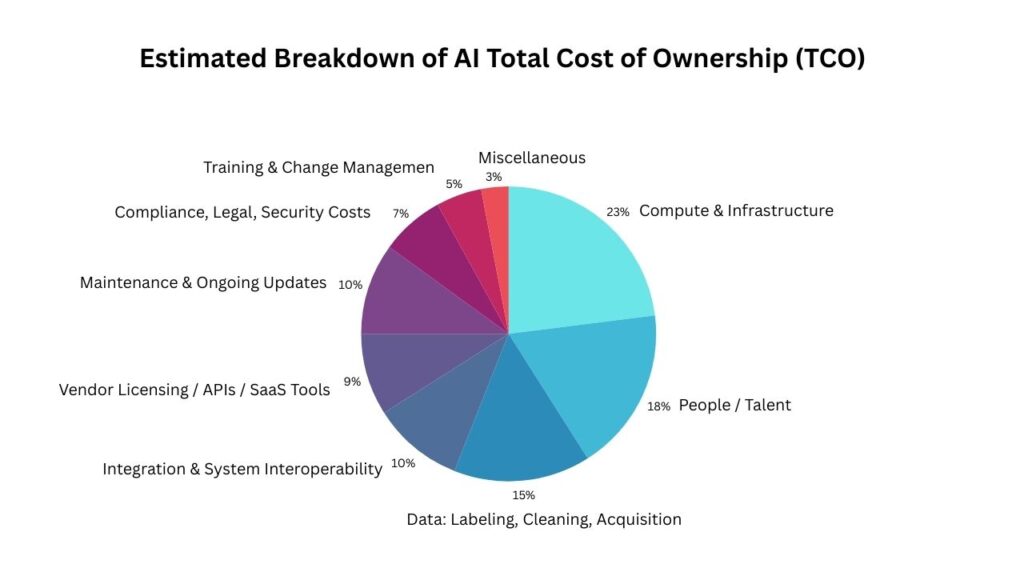
What is the total cost of ownership (TCO), including cloud, staff, tools, and compliance?
AI implementation costs extend far beyond initial development. While model training and integration are visible expenses, you must also factor in cloud compute (e.g., GPUs/TPUs), third-party APIs, vendor licensing fees, and security and compliance audits, especially if you operate in regulated industries. Staffing costs for data scientists, DevOps, and AI product owners also contribute significantly to TCO.
When should we expect break-even and ROI? What does “value” look like in our case?
Return on AI investment should be defined using business-centric KPIs. For example, if a claims automation model reduces human effort by 60%, that’s measurable labor cost savings. Most enterprise AI projects aim for break-even within 12-18 months.
If the model doesn’t deliver value by then, reassess your approach. Defining ROI upfront ensures you’re solving a real business problem, not just experimenting with technology.
10. Prepare Teams for Change Management
AI is not just a technical change, it’s a cultural and operational shift. Success depends on people as much as models.
How will we prepare users to trust, adopt, and co-pilot with AI tools?
Trust comes from transparency and hands-on exposure. Run internal workshops, pilots, and demos that explain how AI works in plain terms. Early engagement drives smoother adoption and stronger outcomes.
Who will lead internal adoption and help resolve cross-team resistance?
Appoint AI champions from product, operations, and leadership who can promote benefits and relay field feedback to development teams.
How will we set realistic expectations for what AI can and cannot do?
Clarify boundaries: AI assists but doesn’t replace expert judgment. Under-promising and over-delivering is better than AI hype backlash.
Conclusion
AI is no longer a future initiative, it’s a competitive advantage today. But successful integration isn’t just about choosing the right model or platform. It’s about aligning technology with business goals, preparing your teams, securing data infrastructure, and governing systems responsibly.
Whether you’re exploring your first use case or planning to scale AI across the enterprise, Samarpan Infotech offers the strategic consulting, technical integration, and long-term support needed to turn your AI vision into an operational reality.
With over 10 years of experience in Tech industry at Samarpan Infotech with architect system, problem solving and creativity. "Today is the only day. Yesterday is gone".